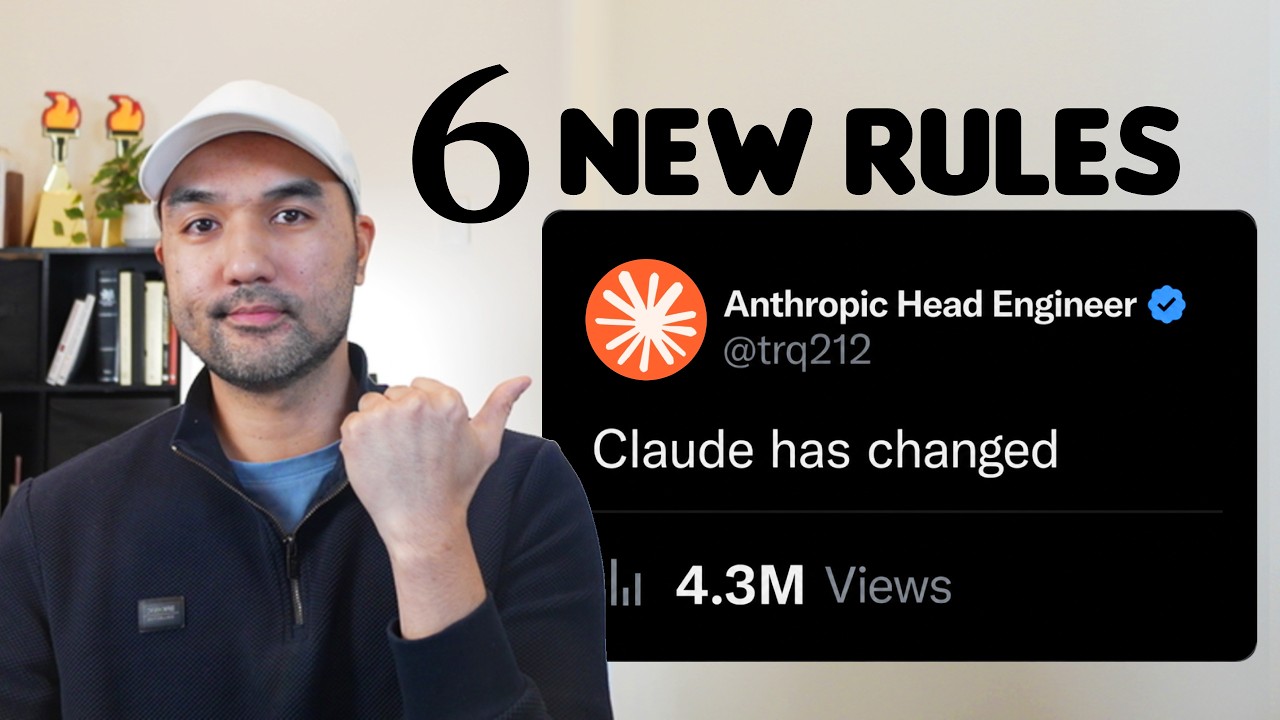
Source statement: newer Claude models need less duplicated scaffolding. Give them room for judgment while keeping real safety boundaries in permissions, hooks, tests, and approval gates.
The six shifts are: rules to judgment, examples to design interfaces, front-loaded context to progressive disclosure, repeated descriptions to concise tools, manual memory habits to automatic memory, and plain specifications to richer references.
Official Claude Code documentation supports the practical direction: keep CLAUDE.md concise, load skills when needed, use nested or scoped context, inspect auto memory, and use /doctor to diagnose installation and configuration issues.
The reported 80 percent system-prompt reduction is a claim from the engineer article discussed in the video. The original X post is linked, but its text could not be independently read during this run.
The presenter's ARMS model, meaning Applications, Routines, Memory, and Skills, is his organizing framework. It is useful, but it is not an official Anthropic model.
doctor-plus is the presenter's third-party skill, not part of Claude Code. Inspect its files before considering installation, and do not confuse its extra six-rule audit with official /doctor behavior.
Source, context, and the ARMS model
The presenter frames context engineering as everything the agent receives beyond the current prompt. His ARMS framework groups that context into applications connected through tools, routines and scheduled work, accumulated memory, and reusable skills. [00:45-03:02]
Source overview at 00:20. The map previews the four context categories the presenter later names as ARMS.Source provenance at 00:55. This is the article the presenter interprets throughout the video.Presenter's framework at 02:15. ARMS is his explanatory layer, not an Anthropic specification.
Inferencethe useful part of ARMS is the inventory question. Before adding more instructions, ask which layer should own the information. A hard safety requirement belongs in an enforced control. A repeatable procedure belongs in a skill. A durable fact may belong in project context or memory. A scheduled check belongs in a routine.
The capability premise and its limits
Source statementthe engineer article says Anthropic removed more than 80 percent of Claude Code's system prompt for newer models without a measurable loss on internal coding evaluations. The presenter uses this to argue that older compensating rules can constrain more capable models. [03:02-05:38]
Model-capability premise at 03:20. The visual communicates a large capability and context shift, but it is illustrative rather than a measured chart.Benchmark evidence shown at 03:50. The presenter uses these charts to support the capability premise. Rankings are date-sensitive and should be checked at the original benchmark before making a model decision.
The practical conclusion is narrower than “delete rules.” Remove duplicated, obvious, contradictory, or derivable guidance. Keep non-obvious conventions, rationale, and real gotchas. Enforce destructive-action boundaries outside prose when possible.
Rule 1: Give judgment, then preserve enforced boundaries
The old pattern tried to prevent every bad output with detailed prose. The revised pattern asks Claude to match the surrounding code's naming, idiom, and comment density, allowing context-sensitive judgment. [05:38-08:24]
Rule 1 summary at 05:45. The shift is about removing compensating prose, not removing enforced safety.Old state at 06:15. Several rigid comment rules try to cover every context in advance.New state at 06:40. One contextual interface replaces several absolute comment rules.
The presenter demonstrates this with a “surprise me” design skill. Instead of prescribing one layout, it asks the model to explore within a taste boundary and produce several directions.
Design exploration catalog at 07:30. The interface preserves the goal while leaving room for different visual answers.Kinetic direction at 07:45. This is one distinct output, not a duplicate frame of the catalog.Wonky and sketch direction at 08:00. It shows the breadth allowed by the same high-level interface.Code-is-ink direction at 08:15. The visual language changes while the underlying task remains stable.
Rule 2: Give design interfaces, not one answer to imitate
Examples can anchor a capable model too tightly to one exploration space. A design interface instead defines the vocabulary, constraints, controls, and boundaries that many good outputs can satisfy. [08:24-10:51]
Rule 2 summary at 08:35. Interfaces set the space in which the model can make choices.Source evidence at 08:40. The article describes how examples can constrain exploration while a well-designed interface exposes capabilities.
The presenter uses a /robo skill connected to a visual brand book. The skill does not just point to a gallery. It exposes colors, fonts, visual motifs, voice, and reusable controls.
Skill relationship at 09:35. The brand interface is a reusable system component rather than a one-off prompt.Interface example at 10:00. Controls express the design vocabulary more clearly than one screenshot to copy.Design-space overview at 10:30. Multiple viable directions can share one underlying interface contract.
InferenceAnthony's planned Alexana master HTML system is exactly this kind of artifact. It should define tokens, typography, spacing, card types, citations, figures, tables, print behavior, and accessibility, then let each document express its own content inside that interface.
Rule 3: Load context progressively through routers
Progressive disclosure means keeping always-loaded guidance small and letting the agent fetch the right detail when the task needs it. The presenter argues that a central CLAUDE.md should route into departmental files, skills, and references instead of containing every operating fact. [10:51-15:02]
Source explanation at 11:00. Specialized context moves out of the always-loaded layer and becomes discoverable when relevant.Tree-of-files pattern at 11:35. A thin root points toward deeper context instead of importing everything at startup.
The visual demonstration moves from the whole workspace to one department and then one router branch. All three states matter because they show the hierarchy rather than one attractive graph.
Whole-system view at 12:00. The outer domains remain visible while the skills branch sits near the center.Department view at 12:40. The workspace has narrowed from the entire operating system to one class of context.File-router view at 13:20. This state closes the reasoning gap by showing that the graph resolves into concrete files.Context-cost comparison at 14:50. A thin router leaves more of each session available for the actual task.
Official Claude Code documentation adds a useful constraint: imported files still load at launch, so imports can organize a large CLAUDE.md without reducing its startup cost. On-demand skills, nested CLAUDE.md files, path-scoped rules, and topic memory files are the mechanisms that actually delay context.
Rule 4: Remove duplicate tool descriptions
Older prompts sometimes repeated tool instructions in the main prompt and the tool description. The revised pattern keeps each instruction at the narrowest useful layer and relies on the model to connect the pieces. [15:02-16:25]
Rule 4 summary at 15:10. The goal is one clear source of truth for each instruction.Old state at 15:25. The same behavior can appear in both the system prompt and a tool description.New state at 16:05. The duplicate examples are removed and the behavior remains in the tool layer.
Inferencededuplication should name one authoritative file and make every other location point to it. This /yt build applies that rule by making Claude's skill directory canonical and letting Codex use the same physical files through a symbolic link.
Rule 5: Use automatic memory, but keep evidence gates
Claude Code now maintains automatic project memory, and official documentation says it records useful learnings and patterns across sessions. The presenter still prefers an explicit /calibrate workflow at the end of productive sessions so the conversation can update skills, routers, memories, and workflows. [16:25-18:04]
Rule 5 summary at 16:25. Automatic memory can remove some manual recording work, but it does not make every observation durable truth.Source comparison at 17:10. The article frames auto memory as the newer default capability.Presenter's implementation at 17:30. The explicit calibration pass reaches several artifact types after a session.
For Anthony's system, the evidence gate remains important. A reported difficulty can adjust the next Teach lesson immediately, but a learning record should require demonstrated understanding, disclosed prior knowledge, or a corrected misconception. Automatic memory should not turn every passing statement into permanent context.
Rule 6: Use references both the agent and human can read
Markdown remains useful for structured text, but visual HTML references can communicate color, layout, hierarchy, interaction, and comparative systems in a form both Claude and the human can inspect. [18:04-20:37]
Rule 6 summary at 18:05. File format should match the information being communicated.Source evidence at 18:30. The argument is for richer working references, not replacing every Markdown file with HTML.Visual-reference example at 19:10. A color system is faster to judge when the colors are rendered rather than named only in prose.Compressed visual reference at 20:15. One page combines the six shifts with example counts for rapid review.Detailed reference state at 20:30. The second frame matters because it shows that the artifact supports both overview and drill-down.
Official /doctor: diagnostics before changes
Official Claude Code documentation describes /doctor as a setup checkup that can diagnose and fix installation and configuration issues. Current documentation says it checks duplicate or leftover installs, PATH and settings problems, unused skills and connected tools against context cost, slow hooks, versions, and CLAUDE.md duplication or derivable content. It reports findings and asks for confirmation before changing anything. [20:37-22:15]
Presenter summary at 21:25. The list covers installation, dead weight, CLAUDE.md, slow hooks, and reporting before fixing.Observed doctor output at 21:40. The diagnostic view separates components, types, scopes, impact, and notes.Human checkpoint at 21:50. The user chooses what to change after reviewing the findings.
The safe operating rule is simplerun official /doctor, inspect its report, and approve selected fixes. Do not assume that every unused component should be removed, because rare but critical workflows can look inactive in a recent-usage scan.
The presenter says official /doctor does not audit all six context-engineering shifts, so he created doctor-plus to run the official check and add a rule-by-rule inspection of skills and artifacts. [22:15-24:01]
Third-party extension at 22:25. The presenter positions it as a more complete context-engineering review.Extended checklist at 22:40. The extra design-interface check distinguishes this tool from official /doctor.Rule audit at 23:00. The table maps individual files to context-engineering findings.Proposed optimization at 23:30. The example identifies a large skill as a candidate for router-based decomposition.
Untrusted-input boundarydoctor-plus is distributed through the presenter's community link. It was not downloaded, read, installed, or executed during this run. Any future evaluation should inspect its source first and compare its claims with official /doctor behavior.
Reasoning model for Anthony's system
The six rules are easier to apply as a decision sequence:
Does this requirement prevent irreversible harm or enforce a real invariant? Keep it in permissions, hooks, validation, or an approval gate.
Is it a non-obvious convention the model cannot infer from local evidence? Keep concise guidance near the affected work.
Is it a repeatable procedure? Move it into an invocable skill.
Is it detailed reference material needed only sometimes? Put it behind a router and load it on demand.
Is it a visual language or interactive pattern? Express it as a design interface or rendered reference.
Is it a lesson learned from one conversation? Record it only when evidence justifies durable memory.
This keeps model judgment available without weakening the controls that protect Anthony's files, clients, money, and external systems.
Tools and resources
Resource
Role in this playbook
Where used
Link
Original engineer article on X
Primary source interpreted by the presenter; text unavailable to the research tool
00:45 onward
https://x.com/trq212/status/2080710971228918066
Claude Code commands
Official behavior for /doctor, skills, and commands
Doctor verification
https://code.claude.com/docs/en/commands
Claude Code memory
Official CLAUDE.md and auto-memory behavior
Rule 5
https://code.claude.com/docs/en/memory
Claude Code extension overview
Official context costs and on-demand skill behavior
Rules 3 and 4
https://code.claude.com/docs/en/features-overview
Debug your configuration
Official context and configuration inspection commands
Doctor verification
https://code.claude.com/docs/en/debug-your-config
Artificial Analysis
Benchmark source shown by the presenter
Model premise
https://artificialanalysis.ai/
Video source
Full presentation and visual evidence
Entire playbook
https://www.youtube.com/watch?v=gQeRjkb_Hlc
Claims to verify
The original engineer article's exact wording, author role, publication date, and 80 percent system-prompt figure could not be independently read from X during this run. Treat those as source claims until the article text is available.
Model names, benchmark scores, rankings, and speed comparisons are date-sensitive. Check the live benchmark before making a purchase or routing decision.
Official /doctor behavior changes by Claude Code version. The current command reference is the authority, not the video's screen recording.
doctor-plus is third-party software. Its source, permissions, network behavior, and file mutations must be audited before installation.
The ARMS framework and /calibrate workflow are the presenter's system design, not official Anthropic requirements.
The presenter connects a reusable brand skill to a visual interface containing colors, type, motifs, controls, and several allowed directions.
System value
A shared Alexana interface can make /yt, Teach lessons, reports, references, and future AI-generated HTML feel consistent without forcing every document into one example layout.
Proposed form
Agentic design-system build, already recorded in the personal backlog
Target project
Personal and Alexana brand
2
Audit the command center with official /doctor before considering doctor-plus
Official /doctor reports installation and context findings before changes; the third-party extension adds a six-rule layer.
System value
The official diagnostic can identify duplicate installs, stale context, unused components, and slow hooks without importing unreviewed third-party instructions.
Proposed form
Read-only diagnostic task followed by selected fixes
Target project
Personal computer tooling
3
Turn the six-rule decision sequence into a printable reference
The presenter uses a calibration skill to update several system layers after productive sessions.
System value
Teach can adapt future lessons immediately from Easy, Challenging, or Stuck feedback while reserving durable learning records for demonstrated understanding.
Proposed form
/yt teach feedback contract, implemented in this build
Target project
/yt and Matt Teach integration
Take this with you
Save the playbook to read later, or hand the raw notes to your favorite AI.
What's this?
The Markdown file (a .md file) is a plain-text copy of this whole playbook, written in the simple format AI chat tools read best. It keeps the headings, links, timestamps, and captions and drops all the page styling. Think of it as the raw notes behind this page, ready to hand to an assistant.
To use it, download the file and drag it into ChatGPT, Claude, or any AI chat (or just paste the text in), then ask for what you want: “Summarize this into a one-page cheat sheet,” “Turn these steps into a checklist I can follow,” or “Quiz me on the key ideas.” Because the file is already structured, the assistant works from the real content instead of guessing.