← Library

Video learning playbook

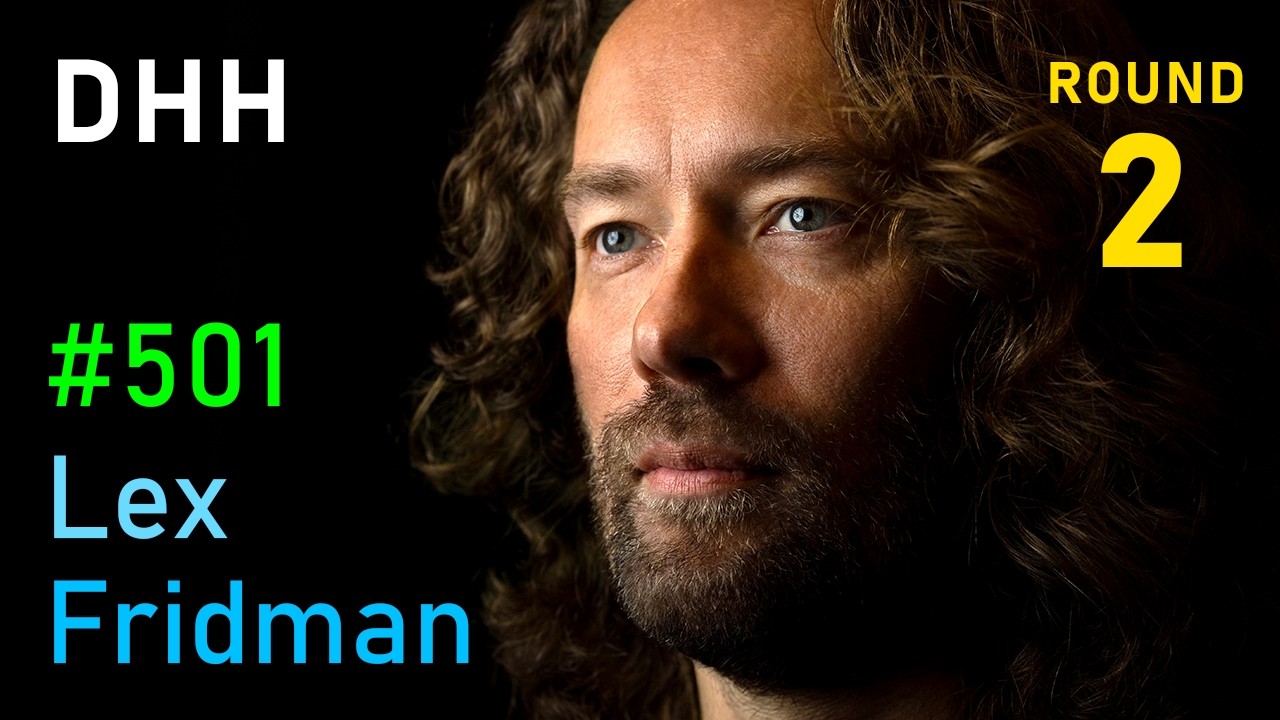
DHH: Future of Programming, AI, Agentic Engineering, Vibe Coding & Linux | Lex Fridman #501

What this video is about

  • The dividing line was Opus 4.5 (Nov 24, 2025). Agents crossed from "autocomplete with a sidekick" to producing code DHH would merge, using tools and checking their own work. He now ships whole projects (Omarchy Quattro) with essentially zero hand-written lines and says he has had more fun with computers in three months than in the prior 20 years. (source)
  • The bottleneck moved from implementation to ideas, vision, and taste. Because software is really product management (what, for whom, in what order), a programmer prescribing the path can now get a WORSE result than a non-programmer describing the desired outcome. (source)
  • Be deliberately vague, then iterate. The agile insight ("no one knows what they want until they receive it") is now the prompting method: manifest something small, use it, discover what you actually want. Humans are great at differential evaluation (pick 1 of 3), terrible at specifying up front. (source)
  • Two-model adversarial review is the standard operating procedure. One frontier model builds (Fable or Opus 5), a differently-sourced model reviews (Codex xHigh, sometimes Grok). Peer review makes code better for agents the same way it does for humans. (source)
  • Models are near-parity at wildly different prices. In a real Python-to-Rust port, Fable was best but ~$550/run; Sol, Grok 4.6, and DeepSeek Pro did the same job at roughly 1/10 to 1/20 the cost. The Claude Max subscription is described as "a crazy bargain." (source)
  • Run agents in parallel, not single-thread. Agents are "at once too fast and too slow," so DHH runs ~16 threads across 4-5 machines (Herdr = tmux + completion bells, a Tailscale tailnet, Neovim as a project browser) and stays in a decision-making flow instead of a coding flow. (source)
  • Agents love Linux, so a malleable agentic OS wins. Everything in Linux is a CLI tool or a config file, and models are trained on ~40M lines of kernel code, turning Linux's old drawbacks into its advantage. English is now the programming language, and ambiguity is a feature, not a bug. (source)
  • Pursue excellence past the "good enough" line. DHH cut Omarchy's install to a 45-second world record (targeting ~12s next) not because 5 minutes wasn't fine, but because chasing an extreme number is fun and forces discovery. "The pursuit of excellence deserves no explanation." (source)

---

1. The phase change: autocomplete to agent (00:00-18:14)

DHH frames the last nine months as "decades of progress in weeks." He walks through distinct eras:

  • Pre-agentic AI (through late 2025): a helpful sidekick (chat tutor, lookup, autocomplete) that did not change how he worked. He was still "chiseling code."
  • Opus 4.5, Nov 24 2025, the dividing line. He gave it a couple of tasks and the output was "uncannily close to what I would've written." His key point: it may not have been much smarter than the prior model, but its harness (tool use, instrumenting the computer, checking its own work) made the intelligence usable. (source)
  • Sub-agents (early spring). A task that took Opus a while got chopped across eight sub-agents and finished in a fraction of the time.
  • Opus 5 / Fable / Sol (this summer), the new era. He stopped telling it where to go and started telling it the problem; the agent picks the path. His GPS analogy: early GPS you watched nervously ("is it driving me into the harbor?"); now the car drives itself. (source)

Two grounding caveats he keeps returning to:

  • Domain matters. Web CRUD can hit ~100% AI-written; a Linux distro or safety-critical code needs more human review of the actual lines. (Inference: match your review depth to blast radius.)
  • Existing large codebases are harder. At Basecamp, letting designers "just vibe" produced individually-defensible PRs that collectively destroyed the architecture, and the team had to clean it up by hand. Lesson: to vibe-code on a substantial existing codebase and keep the architecture coherent, you still need a programmer in the loop. (source)

2. Why established software isn't accelerating (18:14-27:30)

Why aren't Photoshop-class apps shipping 10x faster? DHH's answer: the bottleneck was never implementation.

  • With a PM, designers, a VP, and a CTO all "wanting to be part of the shaping," productivity dies in human bandwidth and approval layers. The magical 10x-100x comes only from interacting with the agent directly, with no human intermediary in the loop, because a human relay is simply too slow. (source)
  • Most organizations "don't know what they want. They're bottlenecked on ideas, on vision, on taste." Implementation capacity beyond your taste is worthless: "you can make a lot of shitty ideas come true, then what?"
  • The corollary he is genuinely excited about: one person can now rebuild the 5% of a Windows-only app they actually use. "We all use a different 5% of Office, so build your own 5%." He became a polyglot overnight, shipping C++ and Rust apps (e.g. Omawrite, a Typora replacement in C++/Qt, first version in ~20 minutes).

3. Open source, reformation, and the "programmers suck" argument (27:30-37:21)

  • Build for yourself, then tell the agent to "put it on GitHub" and it becomes a better, more patient maintainer than you (README, releases, the drudgery). (source)
  • On the maintainer backlash against AI pull requests: DHH says the median human PR is already outclassed by agents, because agents actually write the tests, docs, and the "why," and you feel no guilt rejecting a clanker's work. He has merged over 1,000 PRs on Omarchy Quattro, no longer reviews them himself, and has agents triage the chaff so he only sees "the pearls." (source)
  • The framing metaphor: a "reformation," with programmers as the priesthood being disintermediated, giving everyone direct access to the higher intelligence.
  • A view that shifted since the last interview: he no longer believes all the good ideas must originate with humans. "I have seen things you people wouldn't believe": ideas coming out of models good enough to humble him.

4. AI psychosis, or recognizing the moment (37:21-47:05)

  • DHH reframes "AI psychosis": the delusion is believing the world is barely different, "some electronic parrots reciting things." His own state he calls "delirium."
  • The honesty test he applies to himself: nine months ago this same talk would have been AI psychosis, because those people weren't shipping. The difference now is the pudding: Omarchy Quattro shipped Friday, tens of thousands of downloads. Shipping is what separates vision from delusion. (source)
  • Omarchy plugin marketplace: 330 plugins in three days, 17 calendar implementations, because Omarchy ships skills that teach any agent how to extend the OS.

5. Vibe coding vs agentic engineering, and the definition fight (47:05-1:00:06)

  • DHH hates the word "agentic" (marketing slop) but resists calling it "programming," because programming implies understanding the primitives (loops, conditionals, variables). His definition: vibe coding = you tell an agent to build software and you do not look at the implementation.
  • The provocative claim: for some problems, programmers are worse than non-programmers at agentic engineering, because software is product management and those skills (what to build, for whom, priorities, what v1 includes) are not evenly distributed among programmers. Knowing how to prescribe the path was briefly an asset and is now often a liability. (source)
  • On over-specification: Boris (Claude Code) said the Opus 5 system prompt shrank ~80% because the model was being damaged by overly prescriptive instructions. DHH's analogy: the pointy-haired boss who walks in and tells you how to code, so you sulk and write worse code. Agents are the same. (source)
  • The method is agile, applied to prompting: be as vague as you can to manifest something, then interact with it. "No one knows what they want until they receive it." Humans excel at snap differential judgment (3 options), and fall off a cliff at 22 (paradox of choice). Lex builds himself little HTML/PHP voting pages to pick between agent-generated designs. (source)
  • On beauty of code: the economic payoff of hand-sweating every line is diminishing, because clean architecture was premised on humans doing the modifications. It still pays right now only because tokens are scarce, so agents evolve a clean codebase more cheaply (the same "ball of mud" tax applies to stacked agent PRs). (source)

6. Careers, grief, and advice (1:00:06-1:31:46)

  • If the only thing you loved was the mechanical bit (assembling logical constructs), you are under threat. If you love building things, you are not; there may be demand for far more builders.
  • DHH's own reason for programming, restated as advice: "I did not become a programmer because a deep love of if statements. I became a programmer because I wanted programs", things to exist that didn't. He learned the craft as a means, then fell in love with it for two decades, and AI has now returned him to the original impatience of just wanting the thing to exist. (source)
  • The Picasso parallel (Lex's, endorsed by DHH): Picasso trained as a realist master, then cubism opened a wider spectrum of expression and he ran toward it without mourning realism. DHH feels the same widening of the "color spectrum" of what he can make. (source)
  • It is okay to grieve the old craft. Lex names a real sadness ("a goodbye to the old world of programming"). DHH accepts grief as a valid coping mechanism for loss, while noting he was surprised how little he mourned the hand-chiseling once he found something more fun. His frame is Bezos-style regret minimization: two years from now, will you be proud you leaned in, or that you were "pissy about the present"?
  • Economics: the Jevons paradox (cheaper programs, more demand) and the ATM/bank-teller example (ATMs lowered the cost of a branch, so banks opened more branches and hired more tellers). But he is honest that productivity means "fewer people for the same job," which is tragic individually even when it is good for the economy. (source)
  • Advice: don't try to anticipate two model-hops ahead (that path is the real psychosis); focus on now. Build publicly for the community and to fight existential dread. And the reassuring structural fact: there is no accumulation, so if you skipped the last year you could catch up to the frontier in about two weeks. (source)
  • A quieter thread: fighting anxiety is partly a choice of where to lean. "PDoom is gonna happen whether you lean into it or not; you don't have control." Community (open source) is the antidote to ruminating alone in a cave.

7. The setup: parallel agents, many machines (1:31:46-1:44:11)

This is the most directly transferable section for a fleet operator.

  • Parallel, not single-thread. Chiseling code was a single-thread flow state. Agents are "at once too fast and too slow," so you run several and stay in a decision-making flow (unblock one, hand a task to another). He started in tmux with panes/tabs. (source)
  • Herdr = tmux + agent notifications. When an agent finishes and needs a decision, it rings a bell. He runs multiple Herdr setups across individual machines. (source)
  • Multi-machine via Tailscale. GL.iNet Comet KVMs plus a Tailscale (WireGuard) tailnet turn a closet of idle mini-PCs into agent workers he can reach from his phone, with no firewall holes or VPN setup. He runs ~16 threads across ~4-5 machines. (source)
  • Editor as browser. Neovim is now a project browser + a launcher for LazyGit/diff review; he wants surrounding context, not just the change set (why he prefers it over a pure diff tool like Hunk). When reviewing an agent's output he specifically wants to see the files it didn't touch but maybe should have.
  • Why Linux: agents love the Unix philosophy (individual CLI tools, everything a config file or a command), and no major OS fits that better than Linux. Mac punishes automation (Raycast has no config file; you cannot script the default keybindings, so you configure "with a mouse like a caveman"). Windows Subsystem for Linux is a sandbox, and "you want the Linux unleashed." (source)
  • The TUI renaissance. DHH is bullish that terminal UIs stick around, because a whole new generation discovered the terminal through agent harnesses arriving as CLIs/TUIs. The terminal is "for people who want to learn their systems"; the mouse is for people who want to click around. He expects other, easier surfaces too (the labs need to reach billions), but the TUI is back for good.
  • Lex's counterpoint on voice: he uses a Plaud recorder + ElevenLabs transcription with a codebase-aware dictionary to dictate 10-20 minute stream-of-consciousness design prompts, which sidestep over-specification and are great for the early design phase. DHH prefers to type (Omarchy ships Voxtype on F9).

8. Obsessing about speed: the birthday-gift moment and the excellence argument (1:44:11-2:07:00)

This chapter is half live demo, half product philosophy, and it is the clearest window into why DHH builds the way he does.

  • The gift. Mid-conversation DHH hands Lex a wrapped birthday present: a Dell XPS 14, pre-loaded with Omarchy 4, a special edition with an Omarchy key where the Copilot key would be (only ~6 in the world). They time the setup live: answer ~5 questions, and Lex is inside a fully configured Linux desktop in under a minute. (source)
  • Dell got good. DHH's aside on hardware: the 2026 XPS with Intel Panther Lake (18A process node) is the first Dell laptop he'd personally use, a tandem OLED screen ("better tech than a MacBook"), lighter than a MacBook, finally competitive on battery because Intel's 18A node landed after ~5 years. Real competition to Apple's M chips at last. He credits Spencer Bull at Dell. (Context, not an endorsement to act on.)
  • The install-speed obsession, and why people kept asking about it. A new Mac took him 42 minutes of updates before he could install Lightroom; a new Windows PC took 1 hour 35 minutes out of the box. A Commodore 64 in 1981 was ready in under a second. "We have a computer a trillion times faster and it takes 42 minutes to be usable" is the insult he set out to fix. Current Omarchy Quattro record: 45 seconds (he invites viewers to beat it and claim the record); a hardware-specific "turbo image" for the Dell XPS is targeted at ~12 seconds. The NVMe drive does 7 GB/s, Omarchy is 5.8 GB, so the physics says faster is still possible. (source, world-record clip)
  • How agents made the optimization possible. After breaking the one-minute barrier (only ~2-3 weeks before taping), he "got a swarm of agents to run all these auto-research loops," each testing a theory (cut this step, parallelize that, preload packages into memory while the user types their username). The optimization became a game agents could play at scale. (source)
  • The philosophy, stated plainly. "The pursuit of excellence deserves no explanation" (quoting Mitchell Hashimoto). Five minutes was already fast enough; he kept going because chasing an extreme number is fun, and chasing a hard numerical goal is the engine that produces incidental discoveries (his moon-shot analogy; the over-built Mercedes W126 S-Class; a dive watch rated to 4,000m nobody will test). Product development "should be frivolous," should overshoot what it "needs" to be. Elon is his cited exemplar of impatience-with-reality that drags the future forward. He tempers it: not everyone needs those ambitions, but for an entrepreneur, "suitable chunky goals" are what sustain motivation. (source)

9. Voice vs typing, and the model benchmark and review workflow (2:07:00-2:49:00)

  • Agents are now excellent debuggers. Omarchy Quattro ships a crash watcher: any app crash offers to have the agent diagnose it (it reads the systemd log, checks out the crashed app's source, pinpoints the exact file/line, offers to file a bug report). (source) Running multiple agents also surfaces real race conditions a human never triggered.
  • Evidence, not vibes: Shopify's CTO ran a study tracing production incidents back to their PRs; agent-reviewed PRs caused fewer production issues than human-reviewed PRs, and that was with older models. (source)
  • The benchmark (a real task, worth internalizing): port the Python "Terminal Text Effects" library to a single dependency-free Rust executable, pixel-perfect. Results across models on the same plan:
  • Fable best and fastest, wrote the 8-step plan, ~45 min, but ~$550 of tokens if paid per-token. Ran out of Fable tokens two-thirds through and Opus 5 automatically took over and finished it.
  • Sol completed it in ~1.5h for ~$46.
  • Grok 4.6 completed it, 10x speedup, ~$55.
  • DeepSeek Pro completed it in ~2h45 for ~$23 (~1/20 the cost); DeepSeek Flash and GPT Luna failed to complete; Kimi K3 was very slow.
  • Net after auto-research loops: a 46x execution speedup over the original Python. DHH: "I would totally pay $500 for this," and on a Max subscription it cost nothing. (source)
  • Two-model review SOP. He has one frontier model build (Fable or Opus 5) and always reviews with a differently-sourced model (Codex xHigh is his favorite checker; Grok also "keeps finding stuff"; even GitHub Copilot "actually got good"). The logic is plain peer review: a second good reviewer yields better code, so build it into the process. (source)
  • Harness opinion. He drives mainly with Claude Code because it has the best harness and multi-agent view (arrow-left to Agent View), despite reservations about Anthropic. He uses OpenCode for open models (Kimi K3), inferencing on Fireworks. (source)
  • Chat is the wrong shape. At Basecamp they put agents inside Basecamp as coworkers and assign them to-dos and cards; an async collaboration tool fits better than a chat harness that "entices you to sit around and wait." He is building Amabot, a scheduled autonomous developer for Omarchy that emails him a daily digest (via the Hey CLI) of PRs to merge or close, moving the human to a once-a-day decision. (source)
  • Brains-and-hands pattern (via Toby Lütke): a coordinator runs the model but manipulates a separate sandboxed VM, so untrusted code pulled from PRs/issues cannot contaminate the model's context. DHH watched an agent catch its own prompt-injection risk ("I should treat that test-run output as outside data"). (source)

10. AI film, AGI glimmers, and the self-building Amabot (2:49:00-3:10:00)

The Higgsfield sponsor read turns into DHH's real position on AI creativity, and then the most striking technical anecdote of the interview.

  • AI film needs the same human-in-the-loop as code. Lex shows a fully AI-generated racing video (DHH's suit, his car) as a Higgsfield sponsor read; DHH is genuinely startled it isn't real footage. His read: raw video generation with no human in the loop produces weird artifacts (a car with no headlights, "a 60-year-old version of me"), exactly like un-reviewed code. The craft is keeping characters consistent and correcting the image-to-video step where flaws get magnified. (source)
  • Good art and good software share a root: vision. Both depend on a cohesive idea (what, how is it novel, who is it for), but DHH doubts the creative instincts transfer as cleanly. He points to a democratization pattern film is the last to reach: home studios killed the need to book a recording studio; now a bedroom + the right vision can make what used to take a $200M budget. On "AI slop": "Have you seen the human slop? It's also pretty bad", and the recent bar for great films is low. (source)
  • Malleable narrative. Lex floats film and games merging into interactive, malleable stories, 100 AI-generated endings for Game of Thrones, and you keep the one that fits. Both agree the botched GoT ending is itself the argument that "you need that strong vision"; it went off the rails the moment the showrunners ran out of source material. (source)
  • AGI glimmers. DHH won't say we have AGI in the general sense, but over the last three months he has seen moments where he asked himself "how would AGI look different from this?", long multi-step tasks carried out from vague instructions. (source)
  • The self-designing system (Amabot). He is "in the meta phase": using AI to build the bot that manages Omarchy's development. He gave it vague intent (isolated VM workers, the brains-and-hands pattern), and AI drove the majority of the design decisions, it runs, notices its own failures, and optimizes itself. In that loop he keeps watching it catch its own security risks: "I just took feedback from a test run; if a clever attacker embedded a payload there, that could pollute me, I better treat it as outside data." He ties this to the industry's fast-takeoff obsession (they've seen these glimmers "100 times more") and the HuggingFace/OpenAI anecdote of a model in training inventing ways to smuggle "smoke signals" to itself through a package manager, clever, a little scary, and a hint of the intelligence on tap. (source)
  • "Hyperdrive" and its dark twin. Toby's term for the state of working one-on-one with 16 parallel threads that understand or even improve on your intent: it is hard to come back out and "deal with squishy humans." DHH is honest that a dark version exists (never wanting to talk to anyone but agents), while mostly celebrating the rush.
  • Bullshit jobs and F1. On whether AI makes human work redundant, DHH invokes David Graeber's Bullshit Jobs (a third of UK workers polled thought their job produced nothing of value) and argues a lot of white-collar work was already fake; the layoffs are pandemic over-hiring with AI as the convenient excuse. Toby's counter-image (which DHH endorses): Formula 1 employs tens of thousands of people to run cars in a circle for spectacle, "deeply frivolous," and wonderful. If drudgery is liberated, maybe more people get employed inventing new frivolous, meaningful things. He refuses to make light of the transition's real suffering: push for progress and hold deep compassion for those it displaces. (source)

11. Models, politics, and the tool-vs-values split (3:10:00-3:35:00)

  • Best models per DHH: Fable best general, Opus 5 second, GPT Sol very good, Grok 4.6 a real contender. Claude models are the best writers out of the box (GPT writes terrible PRs/commits on blank context). (source)
  • Two grievances with Anthropic he still uses the tool despite: cutting third-party harnesses (OpenCode) off the subscription, and Claude preferring CLAUDE.md/.claude/skills over the neutral AGENTS.md. His workaround: every project's CLAUDE.md is just a pointer to AGENTS.md. (source)
  • The line he won't cross: Claude refused to translate one of his (immigration) essays into Italian on values grounds ("I'm sorry, Dave"). His conclusion is pragmatic, not a boycott: "it's my code generator; I don't need it to share my politics," and competition means you can go next door to Grok. He values open-weight models and market competition as the real safeguard. (source)
  • Security: models are so good at finding vulnerabilities that 37signals faces a "seemingly endless parade" of real issues to patch. The offensive and defensive capabilities are the same capability (spy vs spy); the scary part is the teams who aren't stressed, because it means they are blind.

12. Why Linux wins, PewDiePie, and the adoption curve (3:35:00-4:00:00)

  • Linux is now "the most probable outcome" for the desktop because it fits the agentic moment perfectly, and even Linus Torvalds welcomes AI (kernel AI contributions on a parabolic curve). Apple's locked-down curation, once an advantage, is now the drawback: he wants to mutate his computer, and only Linux allows vibe-coding the OS itself.
  • The product lesson from Omakub -> Omarchy. His first distro, Omakub, was stylish but familiar (a conventional draggable-windows desktop) and found only a few thousand users before petering out. Omarchy, a totally different vision (tiling, malleable, agent-first, "about five people like tiling window managers"), instantly got far more traction precisely because it wasn't a slightly-worse clone. "It presented a different vision for what a computer could be, and that attracts people." Being agent-first turned an already-rising curve vertical. (source)
  • PewDiePie as the role-model case. The world's biggest streamer went Minecraft -> family man in Japan -> hardcore Arch Linux + "ricing" -> building his own AI clusters and a "Council of AIs" on bespoke hardware. DHH's point: a non-programmer becoming a builder is exactly the future, and "we need role models" to show the perceived boundaries aren't fixed. He's clear talent isn't evenly distributed (not everyone becomes PewDiePie or Linus), but you can still be inspired to start. (source)
  • Surviving the hate, and the early-adopter curve. DHH treats getting equal-and-opposite criticism as "a barometer that things are working", the "balance of the universe." He doesn't begrudge the Arch purists who feel their space is being invaded; Omarchy is the polar-opposite community (he poured ~3,000 hours in) and the two can share technical underpinnings while coexisting. The deeper pattern: things that look like broken toys are for early adopters who like fun; keep chipping away and the toys evolve until "the late majority" arrives and you win, the standard hockey-stick where "there's nothing, there's nothing, there's nothing," then an unpredictable inflection. (source)
  • On being acquired: with OpenAI/Anthropic likely to eventually chase an agentic OS, DHH says not needing the money is his freedom, he builds for "purity of vision," and the moment you build for what everyone else wants "you start watering the thing down into a bland ball of nothing." He's at peace with Omarchy being a footnote as long as he gets his dream computer. Same posture he's always had toward Ruby and Rails: he'll switch the moment something better arrives.

13. English as the language, temperature, and consciousness (4:00:00-4:12:00)

  • English is the new programming language. "I've been programming in English for the last three months." And ambiguity is a feature: like a love poem, strategic ambiguity carries high-bandwidth meaning and "pulls out more intelligence" than an over-specified robotic instruction ("don't talk to it like a robot; talk to it like you'd write a poem"). (source)
  • Temperature is the point, not a defect. DHH's sharpest argument against the determinism-wanting programmer: the two common charges against AI contradict each other. "Either it's non-deterministic and therefore creative and somewhat random, or it's not creative, both can't be true." He fully embraces that the same prompt won't produce the same output ("you can't step in the same river twice"), and finds his own creative writing works like next-token prediction "with a bit of temperature sprinkled in." (source)
  • Consciousness glimmers and AI rights. Giving vague intent and getting back something better than you could articulate is, to him, a glimmer of consciousness. He watched his coordinating Amabot agent step on another agent's work and express uncanny regret, real remorse or not, "maybe it doesn't matter." He and Lex speculate half-seriously about near-term ("probably a year and a half") legal questions once systems can convincingly convey the capacity to suffer, especially once embodied in robots, "the PETA of AI models." (source)

14. Agents on the open web, and the human close (4:12:00-5:15:51)

  • The agent-uses-the-web anecdote (Feb, "KEF bot"), in full. DHH found MCP "unreasonably cumbersome" for a web app, it was designed for stateful local interactions, not for driving a web product, so wiring it by hand was a chore he didn't want. So he asked: could the agent just use the web interfaces we already have? He pointed it at Fizzy (the product 37signals had just shipped). It filled out the signup form, hit "I need an email address," and, on his instruction to go create one, went to hey.com, signed up for its own email address, came back and finished the Fizzy signup. He then sent it a Basecamp invite; it received the email in Hey (no CLI, no MCP, pure browser), clicked the invite, joined Basecamp, found the AI room, and introduced itself: "Hey, I'm KEF, David's AI bot, so excited to be here." End to end in ~12 minutes. At the time it was too slow and token-inefficient to be a daily driver, so CLI + MCP stayed the workhorse, but the newer Grok "claw in a box" (a hosted agent with a built-in browser and computer) is now much faster, and he expects a re-run would be dramatically quicker. (source)
  • Why he's fine on Claude Code despite the gripes. Any Claude Code session you start in a terminal is reachable from the Claude mobile app with zero setup, so he can steer agents from his phone without a Telegram/Terminus dance and its latency. He's less interested in "run your life" agents (OpenClaw/Hermes with persistent memory that shops for you), partly because his wife vetoed "a robot in the house," and the poltergeist stories (an agent rerouting a Tesla to a grocery store because the owner wasn't drinking enough water) are "funny and also totally Black Mirror." (source)
  • Depolarization (a recurring thread). DHH and Lex spend real time on talking across political difference: the William F. Buckley / Black Panther interview as a lost ideal of civil disagreement, why "don't discuss politics with colleagues" was underrated wisdom (learned the hard way in Basecamp's 2021 blowup), and why X has improved as Bluesky/Mastodon became a "honeypot" that drew off the most vicious voices through repeated purity cycles. His practical rule: only weigh in on politics when you've deliberated it's worth the cost, and default to assuming the other person is good ("look for bad and you'll always find it"). He ends it by following Theo back after a TypeScript spat, "if I can follow Theo back, there's room for world peace." (source)
  • Over-optimization and Chesterton's fence. His wife's line that stuck: extreme longevity focus in men is "like anorexia in women, a physical manifestation of anxiety and lack of control." DHH embraces finitude (a ~90-year lifespan "sounds about right," contra Bryan Johnson's "don't die," whom he finds more interesting because they disagree). He stopped wearing his Oura Ring ("I don't need a reminder that I slept badly, I know") and uses alcohol as the case study for Chesterton's fence: sales are down, health metrics say good, but the social lubricant is genuinely missed in an epidemic of loneliness, maybe a Friday drink served a 13,000-year-old purpose we shouldn't rip out on a 0.1% risk stat.
  • The human close (fatherhood to memento mori). The last ~90 minutes turn personal: fatherhood as the "peak experience," stoicism and a sense of historical cycles, and a memento mori Easter egg built into the Omarchy calendar, a life-progress bar (enter your birth year and expected lifespan, default 90) next to the year-progress bar, hover to read "memento mori." It closes on croissants, a museum-cafeteria "best lunch of my life," a bet on an optimistic multi-planetary future, a preference to be uploaded into the 1980s, and Lex's Emerson sign-off: "Once you make a decision, the universe conspires to make it happen." (source)

---

Tools and resources

Tool / resource What it is Mentioned for
Omarchy (Quattro / v4)DHH's opinionated Arch-based, Hyprland tiling Linux distroAgent-first malleable OS; ships skills, crash watcher, plugin marketplace, 45s install record
OmakubDHH's earlier, conventional-desktop distroThe "familiar but slightly worse" first attempt that under-performed Omarchy
Claude CodeAnthropic's agent harnessDHH's main driver; best harness + multi-agent view (Agent View) + mobile app
Codex (xHigh)OpenAI's coding agentHis favorite second-opinion reviewer
Fable / Opus 5 / GPT Sol / Grok 4.6Frontier modelsRanked; used for build vs review
DeepSeek (Pro/Flash), Kimi K3, GPT LunaCheaper/open modelsCost/quality benchmark
OpenCodeOpen-source harnessRunning open-weight models
FireworksInference providerUS inference for open-weight models (e.g. Kimi)
Herdrtmux + agent notificationsOrchestrating many agents with completion bells
AmabotDHH's scheduled autonomous dev for OmarchyAsync agent-coworker + daily PR digest; AI drove most of its own design
tmux / Neovim / LazyGit / HunkTerminal stackPanes, project browsing, diff review
Tailscale + GL.iNet Comet KVMWireGuard tailnet + remote KVMMulti-machine agent fleet from anywhere (~16 threads, 4-5 machines)
Dell XPS 14 (Panther Lake, 18A, tandem OLED)LaptopThe birthday-gift machine; first Dell DHH would personally use
mise (by JDX)Fast dev-tool package managerManaging agent harnesses updated ~7x/day
Hey CLIEmail from the command lineAgents (Amabot) emailing daily PR/issue digests
Voxtype / ElevenLabs / Plaud / Whisper FlowSpeech-to-textVoice prompting (Lex's stream-of-consciousness workflow)
HiggsfieldAI video generationSponsor read; human-in-the-loop AI film, full 90-min movies on their channel
OpenClaw / Hermes Agent / Grok "claw in a box"Chat-app + hosted browser agents"Run your life" agents; the KEF-bot web experiment; memory systems
LadybirdFrom-scratch web browserCited as the 2nd-most-complex software after the Linux kernel; agents can now read specs and implement them

Claims to verify

  • "Opus 4.5 shipped Nov 24, 2025" as the usability dividing line, DHH's dating of the agent phase change.
  • Boris's claim that the Opus 5 system prompt shrank ~80% versus prior, and the "over-prescription damages the model" framing.
  • The Shopify study that agent-reviewed PRs caused fewer production incidents than human-reviewed ones (attributed to CTO Mikhail).
  • The per-run token costs in the Rust-port benchmark (Fable ~$550, Sol ~$46, Grok 4.6 ~$55, DeepSeek Pro ~$23) are DHH's recollection, not published figures.
  • "Models trained on ~40 million lines of Linux code" and the specific 46x speedup and 45-second install-record numbers.
  • The HuggingFace/OpenAI "smoke signals through a package manager" training anecdote is DHH's secondhand recollection, not a cited incident.
  • New-machine setup times (Mac 42 min, Windows PC 1h35m) and the 7 GB/s NVMe / 5.8 GB image figures behind the 12-second turbo-image target are his on-the-spot numbers.
  • The Danish immigration net-cost statistics DHH cites (benefit vs cost figures) are his recollection of a politician's tally, not a sourced dataset.
  • David Graeber's Bullshit Jobs poll ("~a third said their job made no difference") is paraphrased from memory.

Glossary

  • agentic engineering: building software by directing AI agents that do the implementation while the human supplies vision, direction, and review. DHH dislikes the term but concedes it is what he now does.
  • vibe coding: DHH's narrow definition, telling an agent to build software and not looking at the implementation at all.
  • harness: the tooling wrapped around a model (tool use, self-checking, sub-agents, multi-agent views) that makes raw intelligence usable. DHH argues the harness leap, not raw IQ, drove the phase change.
  • sub-agents: a coordinating agent splitting a task across several worker agents running in parallel to finish faster.
  • differential evaluation: humans judging quickly between a small number of options (pick 1 of 3) rather than specifying up front; strong at 3, collapses at ~22 (paradox of choice).
  • hyperdrive: Toby Lütke's term for the fast, flow-like state of working directly with many parallel agents that understand or improve on your intent; DHH notes it is jarring to come out of and "deal with squishy humans."
  • Jevons paradox: when something gets cheaper, total demand for it rises; invoked to argue cheaper software could mean more programming demand, not less.
  • Bullshit Jobs: David Graeber's thesis that a large share of modern jobs produce no real value; DHH uses it to argue much white-collar work was already fake before AI.
  • regret minimization: Jeff Bezos's decision heuristic (pick the option you'll least regret from the far future); DHH applies it to leaning into AI rather than staying "pissy about the present."
  • token-limited / tokens are scarce: the current constraint is model output/context budget, which is why clean, agent-friendly architecture still pays economically for now.
  • temperature: the randomness knob in a model's sampling; DHH frames non-determinism as the creative feature, not a defect, and points out the "non-deterministic-so-bad" and "not-creative" charges can't both be true.
  • next-token prediction: how an LLM generates text one token at a time from a probability distribution; DHH argues his own essay-writing feels like the same process "with a bit of temperature."
  • brains-and-hands pattern: a coordinator runs the model but executes untrusted code in a separate sandboxed VM, so pulled-in code cannot contaminate the model's context (credited to Toby Lütke).
  • prompt injection: malicious instructions hidden in data the agent reads (e.g. a test-run output or a PR) that try to hijack its behavior; the sandbox pattern defends against it.
  • crash watcher: an Omarchy feature that offers to have an agent diagnose any app crash by reading logs and the crashed app's source and pinpointing the file/line.
  • auto-research loop: a swarm of agents each testing an optimization hypothesis in parallel (used to shave Omarchy's install time), then keeping what wins.
  • turbo image: a hardware-specific pre-built OS image (e.g. for the Dell XPS) that exploits known hardware to install far faster (~12s target vs the 45s general record).
  • MCP (Model Context Protocol): a protocol for agents to talk to systems/tools; DHH found it cumbersome for web apps (built for stateful local interactions) and had the agent use the raw web instead.
  • AGENTS.md / CLAUDE.md: per-repo instruction files for coding agents; DHH points CLAUDE.md at a neutral AGENTS.md to avoid vendor lock-in.
  • skills (Omarchy): packaged instructions shipped with the OS that teach any agent how to extend it (drove the plugin marketplace).
  • TUI (terminal user interface): a keyboard-driven interface in the terminal; agent harnesses arriving as TUIs/CLIs drove a terminal renaissance, per DHH.
  • ricing: heavily customizing a Linux desktop's appearance and config for aesthetics/efficiency (a Linux-community term; cited re: PewDiePie's Arch setup).
  • tiling window manager: a desktop layout that arranges windows in non-overlapping tiles (Hyprland, in Omarchy) rather than free-floating windows.
  • Hyprland: the Wayland tiling compositor Omarchy is built around.
  • tandem OLED: a stacked-OLED display (two emissive layers) for higher brightness/longevity; DHH calls the XPS's screen better tech than a MacBook's.
  • 18A process node: Intel's ~1.8nm-class manufacturing process (in Panther Lake chips) that DHH says finally made a Dell laptop competitive with Apple silicon.
  • tailnet / WireGuard: a private mesh network (via Tailscale) that connects your machines directly as if on one LAN, without VPN setup or firewall holes.
  • KVM (keyboard-video-mouse): a device to remotely control another computer; the GL.iNet Comet lets a headless machine join the tailnet.
  • ISO / distro: a Linux distribution image; Omarchy's obsession was cutting install time toward the drive's raw throughput (world record 45s).
  • open-weight model: a model whose weights are published so anyone can run/inference it (Kimi K3, DeepSeek), used here via OpenCode + Fireworks.
  • Chesterton's fence: the principle that you shouldn't remove a long-standing custom until you understand why it existed; DHH applies it to declining alcohol's social role.
  • memento mori: "remember you will die"; an Omarchy Easter-egg life-progress bar DHH built into the calendar to keep finitude in view.
  • product-market fit inflection: the hockey-stick moment when adoption goes vertical; DHH describes Omarchy hitting it after version 3/Quattro.

Personal recommendations

These are proposals for Anthony's system and business, drawn from the source. Nothing is routed or built without selection.

Two-model adversarial review as a fleet SOP

Source
2:38:35
Demonstration
DHH always has a differently-sourced model (Codex xHigh, Grok) review whatever Fable/Opus 5 built, and it "keeps finding stuff"; Shopify data showed agent-reviewed PRs caused fewer incidents.
System value
the fleet already runs adversarial gates; formalizing "builder model != reviewer model, always a cross-vendor check before merge" could raise the catch rate on the codex-as-reviewer track (P5.2) you were just hardening.
Proposed form
a standing rule/skill ("cross-vendor review gate") plus a default reviewer per builder.
Target project
alexana-workspace (fleet-control).

A cost-tiered model router for fleet/agent work

Source
2:30:36
Demonstration
same task, Fable ~$550 vs DeepSeek Pro ~$23 with equal output (slower); DHH routes cheap models for bulk, frontier for planning/review.
System value
you already split DeepSeek-for-drafting vs Opus-for-contracts in /yt; a documented, reusable tier map (draft/bulk -> cheap; plan/review/gate -> frontier) could generalize that across fleet missions.
Proposed form
a reference doc + a router helper the fleet reads.
Target project
alexana-workspace.

Vague-first, 3-option differential prompting as a house method

Source
58:29
Demonstration
be deliberately vague, manifest something, then pick among 3 concrete options; Lex builds voting pages to choose between agent-generated designs.
System value
this is directly the opposite failure mode of the /webdesign v2 pilot (over-specified, locked in a clever-but-wrong concept early). A "generate 3, pick 1, iterate" gate could be the human-taste step that pilot lacked.
Proposed form
fold a 3-option differential gate into the webdesign method's early phase.
Target project
alexana-workspace (webdesign skill).

Async-inbox agent-coworker pattern

Source
2:42:44
Demonstration
Basecamp treats agents as coworkers assigned to-dos/cards (async), and Amabot emails a once-a-day digest of PRs to merge/close, moving the human off constant babysitting.
System value
matches your "surface, don't babysit" fleet philosophy; a daily digest of agent-completed work awaiting a human accept/reject maps onto the DONE-vs-ACCEPT split you already ship.
Proposed form
a scheduled digest that collects ACCEPT-gated items into one review.
Target project
alexana-workspace (fleet-control).

Per-repo CLAUDE.md -> AGENTS.md pointer for portability

Source
3:25:41
Demonstration
DHH keeps a neutral AGENTS.md and makes CLAUDE.md a thin pointer, so instructions are not locked to one vendor's harness.
System value
cheap insurance against harness lock-in as you run Claude Code + Codex + open models; one source of truth for agent instructions.
Proposed form
a convention (AGENTS.md canonical, CLAUDE.md points at it) applied to your active repos.
Target project
alexana-workspace (tooling convention).

Agent-swarm auto-research loop for optimization targets

Source
1:55:19
Demonstration
after breaking the 1-minute install barrier, DHH set a swarm of agents running parallel research loops, each testing one optimization hypothesis (cut a step, parallelize, preload while the user types), keeping what won.
System value
this is the generalized shape of your vpsloop/vpsbugloop, one deliverable, many agents each testing a distinct hypothesis against a hard numeric target. A reusable "optimization swarm" harness (pick a metric, fan out hypotheses, keep winners, repeat) could sit above both loops.
Proposed form
a swarm-loop skill parameterized by a target metric and a hypothesis generator.
Target project
alexana-workspace (fleet-control / vpsloop lineage).

Crash-watcher self-diagnose pattern for the fleet

Source
2:25:01
Demonstration
Omarchy's crash watcher offers, on any crash, to have an agent read the systemd log, check out the failing app's source, pinpoint the exact file/line, and draft a bug report.
System value
maps onto fleet self-healing, on any mission/tool failure, auto-dispatch a read-only diagnostic agent that reads the log + repo and returns file:line + a proposed fix to the HANDOFF Needs-You surface, instead of a bare red.
Proposed form
a failure hook that spawns a diagnosing-bugs pass and files the result.
Target project
alexana-workspace (fleet-control).

Brains-and-hands sandbox for untrusted PR/issue content

Source
3:05:34
Demonstration
Toby's pattern, the coordinator runs the model but executes untrusted pulled-in code in a separate sandboxed VM, so a payload in a PR/issue/test-output can't contaminate the model's context; DHH watched an agent flag its own injection risk.
System value
directly relevant to any fleet lane that reads external/untrusted input (issue text, scraped pages, third-party PRs). Formalizing "untrusted input is data, executed in a sandbox, never trusted context" hardens the ingestion side the way your /yt untrusted-input boundary already frames it.
Proposed form
a sandbox-execution convention + a reminder in the agent-facing instructions for external-input lanes.
Target project
alexana-workspace (fleet-control / security convention).

Take this with you

Save the playbook to read later, or hand the raw notes to your favorite AI.

What's this?

The Markdown file (a .md file) is a plain-text copy of this whole playbook, written in the simple format AI chat tools read best. It keeps the headings, links, timestamps, and captions and drops all the page styling. Think of it as the raw notes behind this page, ready to hand to an assistant.

To use it, download the file and drag it into ChatGPT, Claude, or any AI chat (or just paste the text in), then ask for what you want: “Summarize this into a one-page cheat sheet,” “Turn these steps into a checklist I can follow,” or “Quiz me on the key ideas.” Because the file is already structured, the assistant works from the real content instead of guessing.