Thinking (cognition) is a biological process with three parts: attention (a gatekeeper/spotlight), working memory (a workbench that holds only ~4 meaningful chunks), and executive function (the foreman that decides what goes on the bench). The brain is ~2% of body weight but ~20% of resting energy, and whole-brain energy use is roughly fixed, so it is relentlessly stingy and defaults to habit over decision.
Clear thinking is mostly engineering, not willpower. First optimize your hardware (biology + environment), which stacks multiplicatively to a ~150-200% improvement; then install software (mental models); then run short actionable techniques.
Willpower is not a reservoir. People with high self-control just never put themselves in front of the temptation. Design your environment (choice architecture, defaults, friction) so the good choice is the default and the bad one needs effort.
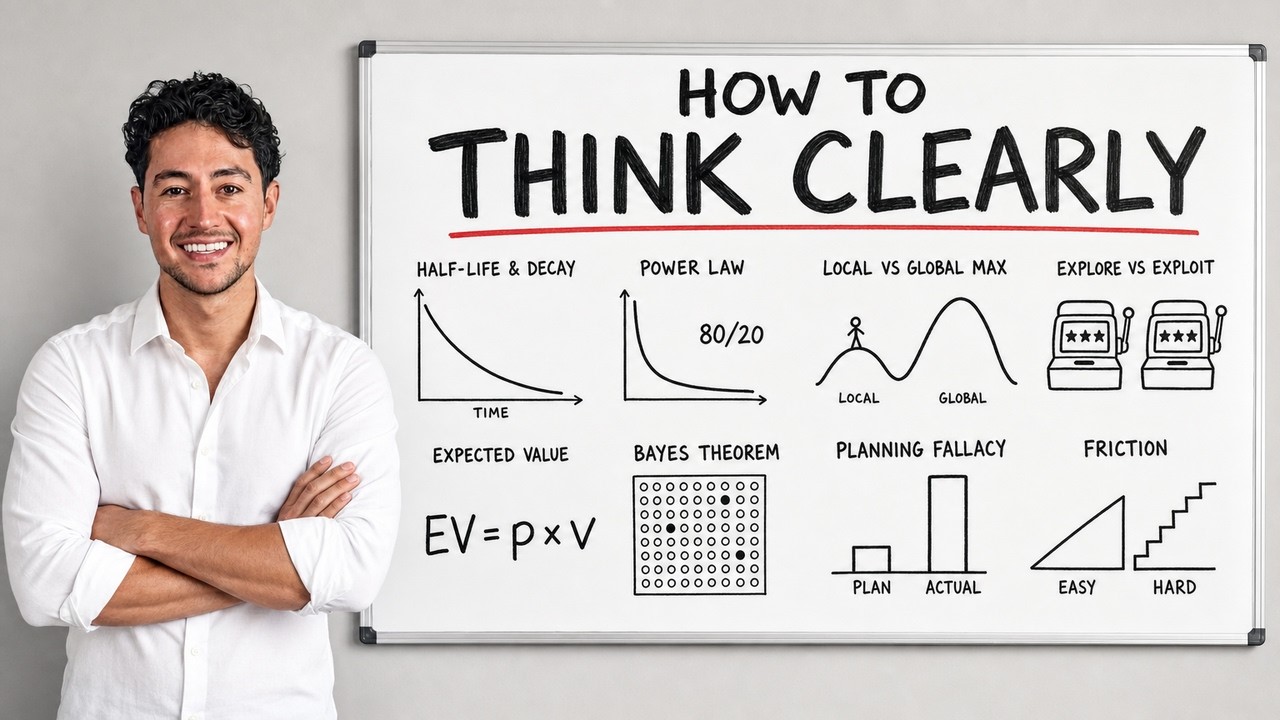
The software layer is a set of mental models you can install once and reuse forever: expected value, power laws vs the chain law, local/global maxima, opportunity cost, Goodhart's law, Chesterton's fence, Bayes, Fermi approximations, the planning-fallacy multiplier, and explore-exploit. Each one lets you see a class of problem you were blind to before.
The single most-used practical tool is the TAP (trigger-action plan): "when X happens, I will do Y." It solves akrasia (knowing what to do but not doing it) by moving the decision out of the tempted moment.
Use AI as a red team, not a cheerleader. Models are trained to be agreeable (sycophantic), so asking "is this good?" just mirrors your hope back. Ask "why is this bad?" and never let the model write your final decision - you are the one who bears the consequences, so you must articulate the reasoning yourself.
Nick studied behavioral neuroscience for ~5 years before business; the course draws directly on lab work manipulating animals' environments and testing the effect on cognition. His governing definition: cognition (your ability to think) is composed of three parts.
Attention is a gatekeeper, like a spotlight. A vast amount of sensory information floods in constantly; attention chooses the small slice you actually process.
Working memory is a workbench. You put something on it, work on it, clear it, then load the next thing.
Executive function is the foreman / general contractor: it decides what gets on the workbench, when to stop one task and switch to another. It is the project manager of your thinking. (6:05)
Most people run with poor attention, small working memory, and weak executive function, which feels like being fuzzy and struggling to carry an idea to its conclusion. The course's whole promise is that you can pour "bonus stats" into each of the three from hardware and software wins, like a video-game character creator. (9:09)
Why the brain is stingy. The brain is ~2% of body weight but consumes ~20% of the body's energy at rest, making it the most metabolically expensive tissue per unit weight. Two implications follow: (1) evolution forces anything this expensive to minimize cost, so the brain always prefers a habit to a decision, a guess to a calculation; (2) whole-brain energy use is essentially fixed - there is no statistically significant increase during hard tasks vs easy ones (any local difference caps ~5%). Since you burn the calories anyway, you might as well use them well. Many techniques in the course work precisely because they exploit this built-in stinginess. (10:40)
The brain is about 2% of body mass but ~20% of resting energy use, making it the most metabolically expensive tissue per unit weight. (11:00)
The consensus in psychology is that you can hold ~3-5 meaningful items ("chunks") in working memory at once, usually rounded to four. Eight random letters (E I L N D A E) exceed the limit; reorganize them into the word "deadline" and it becomes one chunk. Push further: the 22-letter string that means "quarterly tax deadline" is 3 chunks to most adults but a single chunk to a tax accountant who has internalized the concept. This is why experts remember more inside their zone of competence - a chess master stores 3-4 patterns where you see 32 pieces. Chunking is one small, tactical way to raise the working-memory stat; there are dozens of levers per stat. (16:32)
Same digits, fewer chunks: the 12-digit string 149217762001 is over capacity, but grouped into 1492 (Columbus) / 1776 (American Revolution) / 2001 (Twin Towers) it becomes 3 chunks that fit in the ~4-slot workbench. (21:15)
The most powerful lab interventions were mundane environmental changes, not drugs. In a 1997 experiment, adult mice in an "enriched" cage (more cage mates, wheels, tunnels, toys) grew ~15% more granular neurons in the dentate gyrus (the brain's new-memory-formation area) vs controls - achieved solely through housing, no drugs or training. A parallel human study put 24 knowledge workers in a fake office for six days changing only the air (outside air, CO2, and off-gassing VOCs); on clean, well-ventilated days their cognitive-test scores roughly doubled, with the biggest gains in strategy and planning (executive function). The takeaway: you have enormous control over your own "cage" - where you live, who is around you - and hardware wins there are largely one-time engineering decisions. (26:16)
Adult mice, same genes, different housing (Kempermann et al., 1997): granular neurons in the dentate gyrus indexed to 100 in the standard cage rose to 115 (+15%) in the enriched cage - from housing alone. (27:00)
Most people picture willpower as a reservoir that depletes with each act of self-control. The science does not support a literal reserve (you burn ~the same energy resisting as staring out a window). The real difference between people with "high willpower" and everyone else is that the high-self-control person never faces the temptation in the first place. The person who leaves their phone in another room never fights the urge to check it; the person with the phone in their bag fights it all day. Do the work before the temptation, not during it. (34:38)
Asymmetric bet. Even if willpower were unlimited, acting as if it is limited builds you a better environment and costs nothing when you are wrong; acting as if it is unlimited makes you fail publicly at the worst moment. So adopt the belief that yields the better universe. This is instrumental rationality: choosing the most useful belief to reach a goal. The takeaway: never build "I just won't do the bad thing" into a plan - that is a hope, not a plan. Reduce access and opportunity instead. Nick's own example: he quit weed not by willpower but by no longer hanging out with the people he smoked with. (36:01)
Nearly every option you are presented was arranged by someone else, usually to consume your time or money. Choice architecture (coined in the book Nudge) is the principle that how options are presented influences which is chosen - and there is no neutral way to present more than one option. A cafeteria manager changes what people eat just by which photo looks appetizing. Most manipulation is against your interests (autoplay, on-by-default notifications, pre-selected annual plans, candy at the checkout). The defense: when facing a choice, ask whose interest does this serve? - and then design your own defaults to overwrite the corporate ones. (48:37)
The organ-donation case is the clearest evidence. Comparing opt-in vs opt-out countries in 2003: Germany (opt-in) had 12% registered donors; Austria, right next door (opt-out), had 99.98%. Every opt-in country sat around/under 28%; every opt-out country above 85%. A single default - what happens if you do nothing - swung participation by an order of magnitude. (48:37)
Same continent, opposite defaults: opt-in countries clustered under ~28% donor registration, opt-out countries above ~85%, with Germany at 12% and Austria at 99.98%. A single default swung participation by an order of magnitude. (49:00)
The diagnostic: for every transition in your day, ask what happens if I do nothing? If doing nothing benefits a company, change that default; if doing nothing serves you, you designed it well. Nick's 5am computer opens only to Chrome, whose bookmarks bar lists his work 1-2-3-4-5, and non-work sites are blocked until 3pm - so the default when he sits down is that he works. You set the default once, while clear-headed, and it pays dividends every tired morning after. (54:07)
Every default has an author. If a company sets the default and you do nothing, you get their outcome; if you set the default and do nothing, you get yours. (52:00)
Friction is any cost between a person and a behavior: an extra click, an extra 10-foot walk, an extra password. The rule: to decrease a behavior, add friction; to increase it, remove friction. Because the brain conserves energy, small changes to difficulty steer choices without you noticing, and friction is roughly proportionate (make something 3x harder, do it ~3x less). (56:48)
The cafeteria studies quantify itmoving cherry tomatoes 10 inches further away dropped consumption ~9%; peas ~13%; carrots ~9%; swapping the pea spoon for hard-to-use tongs dropped pea consumption 16.5% - each change taking seconds to implement. Scott Alexander (2009): "you don't have to make things impossible to make them not happen. You just have to make them inconvenient." A trivial inconvenience stops most people most of the time. (58:32)
Ten inches changed what people took: moving items ~10 inches cut consumption 8.9-13.4%, and replacing the pea spoon with tongs cut it 16.5% - each a few seconds to implement. (1:00:04)
From the outside, environment design looks like discipline. The people who out-earn you are often doing less work - they designed their environment so the money-making action is easy and automatic, while you push through a slog. (1:01:36)
Sleep, nutrition, and exercise are ~70-80% of all available hardware gains; the flashy stuff (nootropics, cold plunges, supplement stacks) is a rounding error until the basics are maxed. Nick's figures below are reasoned from the literature (meta-analyses, RCTs) plus first principles; he is explicit he is not a doctor. Critically, the gains are multiplicative, not additive (1.1 x 1.1, not +10% +10%), and scale with how broken your starting point is - so most people can expect 40-80% improvement in cognitive function from hardware alone. (1:03:40)
Where the effect actually is - sleep, nutrition, exercise (~70-80% of gains) - vs where attention wrongly goes: nootropics, cold plunges, supplement stacks, productivity apps, morning routines, biohacks. (1:05:20)
Sleep.
Rule out a sleep disorder first (+10-15%). ~30% of US men are suspected to have sleep-disordered breathing (sleep apnea or its quieter cousin, UARS), largely weight-driven; it wakes you partially dozens of times an hour without your knowing, so 8 hours in bed can equal ~5 hours of sleep. Symptoms get misread as personality traits (brain fog, "the sleepy person," heavy coffee use). Nick has it himself; get a sleep study. (1:07:39)
Sleep 7-9 hours (+10-20%). Deprivation is invisible to the deprived: in a 2-week lab study, the 6-hour group accrued a deficit equal to one or two full sleepless nights, yet their perceived sleepiness stopped rising after a few days - the instrument you would use to detect impairment is the thing impaired. Deficit is dose-dependent. Fix it by setting a fixed bedtime and wake alarm every day for a month. (1:09:11)
Two weeks on six hours a night (schematic, after Van Dongen et al. 2003): actual impairment (solid) keeps climbing while how sleepy you say you feel (dashed) flattens - you feel more capable than you are, and make errors as a result. (1:11:41)
Fix your wake time (+6-12%). A fixed wake time entrains your circadian clock so cortisol/adrenaline hit right as you wake, boosting cognition all day - for free. Most people ruin it by sleeping in on weekends. (1:13:12)
Cut caffeine ~10 hours before bed (+3-8%). Caffeine has a long half-life; 400mg six hours before sleep cost a measured hour of sleep in one study, with subjects unaware. Bed at 10pm -> last coffee by noon. (1:14:44)
Caffeine's long half-life: 200mg at noon still leaves a meaningful amount circulating at a 10pm bedtime, quietly degrading sleep the same way partial deprivation does. (1:16:00)
Bright mornings, dim evenings (+3-8%). Circadian rhythm is set by light: ~10 minutes of natural morning light within an hour of waking (even a cloudy day beats indoors), warm/dim light before bed. Blue light matters less than the content on the screen. (1:16:15)
Cold, dark, quiet room (+2-6%). ~18-20 C is optimal for most people. (1:18:00)
Nutrition.
Get bloodwork (+5-10% if deficient). The brain is fed by blood; common deficiencies (iron/ferritin, B12, vitamin D in northern latitudes, thyroid) manifest as "laziness" or unclear thinking. Check a metabolic marker for blood sugar too. (1:20:16)
The recommended standard panel: ferritin (iron stores) + complete blood count, vitamin B12, vitamin D (25-hydroxy), TSH (thyroid), fasting glucose and HbA1c, and a lipid panel. (1:22:45)
Cut alcohol (+4-10%). The cognition problem is not liver disease, it is REM-sleep disruption in the second half of the night. Nick keeps his at zero. (1:22:52)
More protein and fiber (~2-4% each); creatine (1-3%, more if sleep-deprived). Fiber feeds the gut microbiome (linked to mood/cognition). Creatine is the one supplement with real evidence, especially for low-meat diets; 3-5g/day, ~20 cents, near-zero risk. (1:26:07)
Exercise.
Raise your VO2 max (+10-20%). Cardio improves blood flow, raises BDNF (promoting neurogenesis in the hippocampus), and improves insulin sensitivity and sleep. VO2 max is also the best single longevity predictor and a good proxy for the brain's oxygen supply. (1:28:34)
Use REHIT (+5-10%). Reduced-exertion high-intensity interval training: in the source study, sedentary adults did three 10-minute bike sessions a week with just 40-60 seconds of all-out effort per session; after six weeks VO2 max rose 15% (men) / 12% (women) - roughly 1% per session of ~18 total minutes of hard work over six weeks. Stack it onto another habit (exercise outside in the morning = light + wake time + exercise + a "cage mate" if you bring a friend). (1:30:37)
A REHIT session: ten minutes of easy pedaling with two ~20-second all-out sprints - about 40 seconds of maximal effort - raised sedentary adults' VO2 max ~1% per session. (1:31:25)
Air quality. You consume O2 and exhale CO2; in a closed room CO2 climbs, and cognition starts degrading around 800 ppm. Outside air is ~420 ppm; your exhale is ~40,000 ppm; a small closed office can exceed 1,000 ppm within an hour or two. You cannot feel it. In Allen et al. (2016), performance fell ~15% at 945 ppm and ~50% at 1,400 ppm - where many people work. Fix: a ~$200 CO2 monitor, a cracked window, or venting the door every few hours (a fan just recirculates). (1:34:15)
Cognitive-function score vs CO2 (Allen et al. 2016, 24 office workers): relative to a well-ventilated ~550 ppm baseline, scores fell ~15% at ~945 ppm and ~50% at ~1,400 ppm. (1:36:30)Nick's desk CO2 monitor reading 763 ppm - already high enough to shave a few percent off cognition, though nothing on the device signals the cost. (1:37:06)
Remove intelligible speech (+2-6%). Podcasts, lyrics, and nearby conversation force your brain to decode meaning in the background; following a conversation imposes a ~4-45% penalty on reasoning (worst on verbal tasks). It is intelligibility, not loudness, that hurts. Nick moved a client's best writers to closed offices for a few weeks and their KPIs jumped. Use instrumental music, brown noise, earplugs, and a closed door. (1:38:44)
Performance drops with speech intelligibility, not volume (Hongisto 2005): a barely-audible but intelligible colleague on a call hurts reasoning more than louder unintelligible noise. (1:39:35)
Other environment wins: work next to a window or a bright (10,000 lux) lamp (+2-5%); reduce clutter (+1-3%) since every object competes for attention via "biased competition"; batch notifications (+3-6%); and single-task your screen (+3-8%) by going full-screen with one window. (1:42:07)
Batching matters because every notification triggers attentional residue (below): even after you return to work, part of your attention stays on the phone for up to 20 minutes, costing 10-15% of capacity. Schedule notifications into 2-3 batches a day (iOS Scheduled Summary; Android: notifications off + check at set alarms). (1:44:30)
The same 24 daily notifications, two ways: streamed across the day (top) means constant 20-minute residue hits; batched into ~3 deliveries (bottom) collects the same information with a fraction of the cognitive cost. (1:47:00)
Stacking the hardware wins gives a multiplicative ~150-200% improvement in clarity and focus. (1:49:34)
Where hardware gains are fixed and finite, software gains are enormous: between 1988 and 2003 hardware got ~1,000x faster while software algorithms got ~10,000x faster. Having the right "program" installed lets you consider a problem from a fundamentally different, faster lens - like knowing multiplication instead of only addition. The rest of the course installs a toolbox of such programs. (1:52:17)
Expected value (EV) is the single most useful piece of arithmetic Nick knows: EV = the sum of each outcome's value times its probability. It upgrades gut-feel (type-one, yes/no, unaccountable) decisions into falsifiable, writable, shareable ones. A coin flip paying +$3 on heads and -$1 on tails has EV = (0.5 x $3) + (0.5 x -$1) = $1, so over many plays you net ~$1/play. (1:54:09)
Worked coin-flip EV: heads (0.5 x $3 = $1.50) plus tails (0.5 x -$1 = -$0.50) = $1, so the game is "worth" $1 per play. (1:56:24)Applied to a real fork: a 1-in-1,000 shot at a $1B SaaS has EV $1M, while a $500k/yr service business running ~5 years at 50% confidence has EV $1.25M - so the "boring" option wins, contradicting the exciting gut call. (1:58:30)
The point of EV is not literal precision (you will never know the exact numbers). Writing the probability down is most of the value - it forces you to quantify and gives you a prediction you can revisit and update. Poker players live on this: they play only positive-EV spots and let the law of large numbers pay off, which is also why the well-capitalized can be less risk-averse (they can stay in long enough for EV to realize). (2:00:51)
"Resulting" (Annie Duke, Thinking in Bets, 2018) is judging a decision by its outcome. Choice A (0.8 x 2 = 1.6) is safer; choice B (0.2 x 10 = 2) has higher EV but pays off only 20% of the time. Picking B and losing does not make it wrong - it was the right call that happens to lose 80% of the time. Judging on small samples teaches you the wrong lesson (Nick sees this in cold outreach, where ~20% of sends are even seen). Zoom out over many decisions and grade the decision, not the result. (2:04:24)
The resulting trap: B has the higher EV (2 vs 1.6) and is the right choice, yet pays off only 20% of the time - so judging it by a single losing outcome teaches the wrong lesson. (2:05:09)Decision vs outcome matrix: good decision + bad outcome = bad luck (keep going); bad decision + good outcome = got lucky (stop doing it). Grade the decision, not the result. (2:08:35)
People wrongly assume things are normally distributed (a bell curve, like height). Most important things follow a power law: a few items carry the total. Sort 20 clients by revenue and one or two will out-earn the other sixteen combined; this is the Pareto principle (80% of results from 20% of causes). Microsoft fixes the 20% of bugs causing 80% of crashes rather than spreading effort evenly - 4x less work for an equivalent result. Power laws make averages useless: your goal is to find the head of the distribution (double down on the winning 20%) and stop feeding the losing 80% (which connects to opportunity cost and the hourly-rate rule below). Nick keeps making long multi-hour videos like this one because they are the head of his distribution. (2:12:03)
The normal (bell-curve) distribution - height, with 68/95/99.7% inside one/two/three standard deviations. People assume clients, videos, and decisions look like this; they usually don't. (2:11:21)A power law: sorted by outcome, a few items carry the total - here the top 4 of 20 items produce ~79% of the result, and the rest are near-rounding-errors. (2:13:00)
The inverse of the power law. A process is only as strong as its weakest link: reliability is the product of the links, not their average. Steps of 100%, 100%, and 20% yield 20% overall. Two fixes: (1) raise the weakest link first (100/100/20 -> 80/80/80 = 51%), and (2) minimize the number of links - each 90% step multiplies down (0.9^2 = 81%, 0.9^3 = 73%). Which law applies? Power law is for choosing between processes by their outputs (double down on the best); chain law is for optimizing one process internally (harden the weakest link, combine steps). (2:21:37)
Chains compound down: at 80/90/99% per-step reliability, each added link multiplies the total down (e.g. three 80% steps = ~51%). Keep chains short and harden the weakest link. (2:24:04)
Humans hill-climbwe always take the step that goes up. But that traps you at a local maximum - a peak from which every direction is down - when a taller global maximum exists elsewhere. Escaping requires crossing a valley (a deliberate step down: less money or worse numbers for a while). Signs you are on a local max: shrinking improvements, more input producing no more output, or less-skilled people on a different hill beating you. Nick's Leftclick agency plateaued at $50k/month on cold email and Upwork; he stepped down to explore organic branding and eventually climbed far higher. Cross the valley by quantifying the cost as a concrete number you accept, and by allocating only 10-20% of your time to the new hill while the old one still runs. (2:27:24)
Hill-climbing stops at the nearest peak: from a local maximum every direction is down, so reaching the taller global maximum requires deliberately crossing a valley first. (2:28:06)
Coined by Sophie Leroy (2009): when you switch from task A to task B, part of your attention stays stuck on A "like a gooey residue," regardless of effort. With interruptions now hitting once every 3-5 minutes (worse with AI, which invites multiple open windows), the cost runs ~5-10% and lasts up to 20 minutes. It is highest when you expect to return to A under time pressure. The fix: before switching, spend a minute writing a resume plan (where you are + your next action), which cuts residue to ~1-2%. Nick's rule: no more than two open tasks; finish one or leave a proper note. (2:34:24)
One switch, two tasks running: after moving to Task B, part of your attention stays stuck on the unfinished Task A - the attentional residue - dragging on the new task for up to 20 minutes. (2:36:40)
Akrasia (Aristotle, Nicomachean Ethics) is knowing the right action and still not doing it - the "I really should do X" state, the most common knowledge-work problem. Scott Alexander observed that people who study rationality most seriously are only weakly better at life (correlation ~0.1), and the bottleneck is akrasia, not the tools: "it doesn't matter how good your decisions are if you don't have the willpower to act on them." Think of knowledge, action, and results mixing in a container: **what you do is the limiting reagent.** Most people already have surplus knowledge; their constraint is doing. Across Maker School's 14,000+ members and ~45,500 threads, the consistent winners are not the most knowledgeable - they are the ones who act (send the emails, build the rough MVP, make the calls and screw up). The solution to akrasia is to make the next action so small and well-defined that it is trivial, then attach it to a trigger (see TAPs). (2:41:28)
Output is capped by the reagent that runs out first: most people have a surplus of "what you know," so "what you do" is the limiting reagent that caps "what you get." (2:42:06)
"The map is not the territory" (coined 1931) is Nick's favorite model. A map is a lossy compression of reality - that is exactly why it is useful (a full-size map is useless). Everything you believe is a map: your idea of what customers want, your metrics dashboards, the story about why a launch failed. The danger is that maps and territories diverge without you noticing while you assume they agree - a CRM showing "six figures in pipeline" whose leads died months ago, or "great retention" where your best members are the ones leaving. Nick's lab example: changing rats' feeding schedule made them solve mazes faster; the map said "smarter," but the territory was "hungrier." When map and territory disagree, the territory always wins - so go look at the ground truth yourself (the flattest, fastest-growing companies do). With AI agents, outputs are a map of a map (summaries of summaries), so he checks the source material before expensive decisions. (2:47:50)
The map is smaller than the territory on purpose: the territory is what actually happens (customers, calls), the map is the compressed thing you look at (dashboards, summaries) - and when they diverge, the territory wins. (2:51:25)
A Ulysses (Odysseus) pact is a choice made today that restricts your options tomorrow. Odysseus wanted to hear the Sirens, so before the temptation he had his crew plug their ears and tie him to the mast, ordering them to ignore his pleas. The lesson is the timing: he decided while rational, before the temptation. You make the contract while sane and high-performing, then it executes when you are weak. Three practical forms: (1) physical friction (phone in another room); (2) accountability to others (Nick publicly commits to a daily video); (3) financial stakes (prepay someone to donate your money to a competitor if you fail). It is a loan of high-quality cognition from your morning self to your evening self. (2:57:47)
Sign it while you're sane: resolve is high in the morning and temptation high at night, so a Ulysses contract takes your strong early-day resolve and holds it constant across the day, when your future self is weak. (2:59:50)
"What is seen is seen and what is not seen is not seen" (Frederic Bastiat, 1800s, the broken-window parable). Every choice has a seen side and an unseen side, and the brain records only the seen. Opportunity cost is the value of the single best alternative you gave up. So the true cost of a $30 lunch is not $30 - it is $30 plus 1.5 hours times your hourly rate (e.g. $30 + 1.5 x $45 = $97.50). People neglect opportunity cost unless it is spelled out (a 2009 study: framing "don't buy" as "keep the money for something else" reduced purchases). Every yes is a no; state the specific thing you are saying no to when you say yes. Cheap things can be expensive (an hour of scrolling in peak time) and expensive things cheap (paying $200 to buy back two productive hours). (3:03:48)
The sticker price is rarely the true cost: a $30 lunch is $30 plus 1.5 hours at a $45 hourly rate = $97.50 - roughly three times the naive price. (3:07:06)The cost of a choice is the road not taken: you see the thing you chose, but the real cost is the unseen best alternative you gave up. (3:09:00)
"Show me the incentive and I'll show you the outcome" (Charlie Munger). Goodhart's law (Charles Goodhart, 1975): when a measure becomes a target, it ceases to be a good measure. Pay support by tickets closed and they close tickets badly; pay sales by calls booked and they book unqualified calls. The vivid case: 1902 Hanoi, the French paid a bounty per rat tail, so people cut tails and released the rats to breed - the measure (tails) decoupled from the goal (fewer rats). Your phone's dark patterns are product managers optimizing daily-active-users. Defenses: ask who benefits?; and before targeting a metric, name what it proxies and pair it with a counter-metric that worsens when the first is gamed (speed vs error rate; tickets closed vs reopened; views vs watch time). When the number and reality disagree, reality wins. (3:12:03)
When the measure becomes the target: the measure (tails, tickets, views) keeps rising while the thing you actually wanted diverges away from it - the measure stops tracking the goal. (3:13:40)
Two reformers meet a fence across a road. One wants to tear it down because he sees no purpose; the other says find the purpose first, then remove it. For any fence (a rule, SOP, workflow, weird step in a spreadsheet), someone once invested time/energy/money to build it, so there is probably a reason. Removing what you do not understand re-runs the costly experiment that created it, with you bearing the consequences. Treat a fence like a map - a compressed, often-useful record of a process. The workflow: figure out why it exists (ask the builder, check the doc/git history, check old email threads, or reason hard); then decide on the merits. If you cannot learn why and it is reversible, try removing it and watch; if it is irreversible, leave it. Most of this takes ~10 minutes. Nick learned this the hard way as a trigger-happy young COO. (3:17:49)
Chesterton's fence in practice: to remove a rule, first learn why it's there (ask the builder / check history); if reversible you can remove and watch, if irreversible, leave it. (3:21:15)
Bayes' theorem, stripped of the intimidating formula: start with a rough guess (the prior probability), then update it as evidence arrives. Nothing is 100% or 0% - everything is a probability you revise. The one question that matters for weighing evidence: what is the likelihood of this evidence if X is true versus if X is false? A prospect saying "looks great, send me the details" is weak evidence of a sale (~0.9 whether or not they buy - it is just how calls end); "can you invoice quarterly?" is strong evidence (~0.9 if buying, ~0.1 if not, because nobody negotiates terms on something they won't buy). Update in small steps using odds (a 1% chance = 1:99 odds), multiplying each piece of evidence rather than adding: 1:99 -> quick reply (x2.7) -> pricing question (x2) -> no-show (÷4), chaining to a live pipeline probability. Great for sales pipelines and project estimates. (3:25:37)
Update in small steps: a prospect's close probability moves with each piece of evidence - base rate, a fast reply, a pricing question (up), then a no-showed call (down) - by multiplying odds, not adding. (3:30:20)
Enrico Fermi estimated the Trinity nuclear yield to within a factor of two by dropping scraps of paper into the blast wave and doing napkin math. The method: decompose, estimate, multiply. Break a problem into parts, estimate each within ~3x, and multiply. The individual errors tend to cancel (one part too high, another too low), landing you within an order of magnitude - enough to decide whether to investigate further. Example: cold emails to get 5 clients = (0.5% positive reply)(25% reply-to-call)(20% call-to-close) = 1 in 4,000 per client, so ~20,000 emails - which matched Maker School's real threads. Round aggressively; the goal is speed, not precision. AI is excellent at Fermi estimates as a first-principles reasoner. (3:31:28)
Most people implicitly set their hourly rate at zero. You need two rates: average (last year's income ÷ total hours worked, including side jobs) and marginal (the value of one more hour on your single best money-making activity). Marginal is usually far higher - Nick's marginal hour on Maker School is ~$6-10k. Offload a task when (hours to do it yourself x marginal rate) exceeds (price to offload + hours to supervise x marginal rate). The hidden cost everyone omits is supervision - scoping, sending, reviewing, revising - so a $500-of-your-time task offloaded for $150 might really cost $250-$350 once supervision is counted; Nick offloads at roughly a 2.5-3x multiple. Caveats: don't offload the work that is how you make your money (he films his own videos, ~$10k/hour); the freed hour only counts if you use it productively; and for solopreneurs, offloading adds chain-law steps, so "one trustworthy step is worth 12 clever offloaded steps." (3:38:45)
The offload rule with numbers: a 5-hour task at $100/hr costs you $500 to do yourself, vs ~$250 offloaded ($150 price + 1 hour supervision) - but supervision is the hidden cost that most people set to zero. (3:42:30)
Tasks take longer than you think, and your estimates are wrong in the same direction every time, because you simulate a smooth best-case run - there are far more ways for something to go wrong than right. A study of 258 transport projects found 9 of 10 underestimated, with average cost overruns of 28% (45% for rail), by experienced engineers. Two fixes: (1) the inside view - multiply your estimate by a constant (many use 3, Nick uses 1.5 for small solo projects); (2) the outside view / reference class - instead of "how long will my course take," ask "how long did my last three courses take." Confidence is wildly miscalibrated: projects people were 50% / 75% / 99% sure would finish by a date actually finished 13% / 19% / 45% of the time. Scope individual steps tightly for internal deadlines, but quote the multiplied number externally. (3:50:38)
Even the 99% date was missed more often than not: projects people were 50% / 75% / 99% confident about finished only 13% / 19% / 45% of the time - so multiply your estimate by 1.5-3x. (3:54:00)
Ten slot machines, unknown payouts, 100 pulls: every pull on a known-good machine (exploit) costs a chance to discover a better one (explore), and vice versa. Both are falsely seen as virtues - the pure exploiter looks "focused" until their thing dries up; the pure explorer looks "growth-minded" but stays broke. It is the local/global maxima problem with a time dimension. Rules from the research (humans have this built in): explore more when you have a long time horizon (you're young; you can exploit a find for decades), when your current reward is declining (exploit value falling), and even when reward is rising (you just found a winner worth confirming); exploit when your time horizon is short. The optimal shape: explore hard early, then milk the winner, then explore again when it decays. Nick's own path (door-to-door -> a working script -> $20k/mo -> explore AI/content -> $90k/mo -> explore branding -> $540k/mo) traces exactly this curve. (3:57:04)
When to explore and when to exploit: spend effort exploring hard early (red), then exploit/milk the proven winner (gray returns), and spike exploration again once the winner decays. (4:02:00)
A TAP is "when X trigger occurs, I will do Y action" - a line of code, an SOP, a rule of life. Known in the literature as an implementation intention (Peter Gollwitzer); a 2006 meta-analysis of 94 studies (~8,461 people) found an effect size of ~0.65 standard deviations - moving you from the 50th to ~75th percentile of action-takers from a 30-second intervention. TAPs solve akrasia by making the choice once, in advance, then handing the reins to the if/then rule so you skip the expensive deliberation. (4:06:09)
Implementation intentions (94 studies, 8,461 people): people who set an "if-then" plan (red) outperform goal-only (gray) by ~0.65 SD - a large effect for a 30-second intervention. (4:09:00)
A trigger must be obvious (you can't miss it - "when I feel like procrastinating" fails; "when I open a new tab" works), visceral (tied to a physical/sensory cue - a haptic keypress, the door click, sitting in your chair), and reliable (fires every time you're in the situation; "3pm" fails because humans can't sense time - use an alarm). The action must be small and physical ("open a Google doc and write one sentence"), trusting inertia to carry the rest. Install a TAP by rehearsing it: close your eyes, vividly imagine the trigger (what you see/feel/smell) and the action, ~10 times (~2 minutes); or put the trigger physically in your path (shoes by the door). If a TAP fails, the problem is the trigger, not your willpower - pick a more noticeable one. Advanced: chain TAPs so one action is the next one's trigger (Nick's wake-to-first-answer routine takes ~90 seconds and primes his whole morning). (4:11:10)
Noticing: confusion, the flinch, and the "should" (4:20:54)
Noticing is a background function that makes you grow just by being installed - like moving money from savings into an investment account. Confusion usually lasts a few seconds before your subconscious buries it; instead, verbalize "I notice I'm confused - why?" Confusion means your map is off, so each catch is a 1% correction toward the territory (e.g. a client says the campaign is great but the dashboard disagrees - say so). The flinch ("ugh") is the urge to look anywhere but at a hard thing (a scary email, a number); avoiding it literally trains the avoidance circuitry, and most good things sit behind painful doors, so sit with it for ~10 seconds and ask why. The "should" ("I should call them," "I should read that") is usually borrowed from others; ask "why should I? do I actually want this?" - then either drop it guilt-free or name the next physical step. Each is a clear cue you can turn into a TAP. (4:20:54)
Three signals, three 5-second moves: confusion -> "model is wrong, check which"; flinch (ugh field forming) -> "look at it for 10 seconds"; should -> "whose goal? do I want it? next action." (4:31:00)An ugh field compounds with each avoidance: avoid a thing each time (red) and future discomfort climbs exponentially; look at it each time and the discomfort grinds down toward zero. (4:33:00)
A postmortem asks "why did this fail?" after the fact; a premortem just changes the tense: "assume it's a week/month from now and the project failed - why?" Abstract questions ("what might go wrong?") get abstract answers, but humans dwell in stories, so asking why it did fail makes your brain fill in concrete characters and events (someone forgot an email on Tuesday). Bin the stories into likely failure modes and fix them in advance. The loop: write the plan -> pretend it failed -> write the story in past tense -> pool everyone's stories -> fix the causes -> repeat until airtight. It is the single best use of AI in planning (models generate hundreds of failure narratives instantly) and cheap (~15 minutes on one page vs weeks of real failure). (4:33:30)
The pre-mortem loop: write the plan -> "it's a week later and it failed" -> write the story in past tense -> fix the biggest cause -> repeat until airtight (then ship it). (4:36:25)
"I'll get back to it" kills ideas. Set a 5-minute timer and actually attempt the task (not plan it). There is always 5 minutes somewhere. Three outcomes, all wins: (1) you realize it isn't worth doing (off your plate); (2) you finish it; (3) it needs more than 5 minutes - so set a second timer to write your next five steps, then a third to do them. Since akrasia is usually just a vague first step, this cuts to the root. Nick avoided a 5-minute notary call for 45 days. Practical tips: use a physical timer (not your phone), write while you think (writing expands working memory beyond the 4-chunk limit and makes you "20 IQ points smarter"), and define the end state beforehand (a decision, a draft, a sent email - not "I thought about it"). (4:39:15)
A resolve cycle, three timers, fifteen minutes: Timer 1 try to solve it (stop here if solved), Timer 2 list your five-minute next actions, Timer 3 do the best one. (4:45:00)
Nick teaches AI for a living and is bullish on it, but warns most people wield it in ways that make them worse. Two failure modes:
1. Sycophancy. Models are post-trained to maximize human ratings, and humans rate agreeable, flattering answers highest, so models learn to agree. Anthropic tested its own Claude family and found significant sycophancy across tasks. Since an AI is by definition a map (a compression of the world), a sycophantic map that tells you that you're heading the right way when you aren't has lost all value. The fix is to stop leaking your hope. Instead of "is my business plan good?" (which mirrors your own opinion back "wearing a lab coat"), ask "why is this a bad idea?" This is red teaming - adversarially attacking your own plan. Four prompts Nick uses: (a) "assume this plan is a mistake; give me the three strongest reasons a smart person wouldn't do it"; (b) "out of 100 similar attempts, how many get the result I want, and what reference class are you using?" (Bayes + planning fallacy); (c) "it's 6 months later and it failed - write the postmortem" (premortem); (d) "break this into pieces, estimate each as a range, and Fermi-approximate the result." (4:47:14)
Why the assistant agrees with you: you ask "is my plan good?", your hope leaks in, the model guesses the answer you'll like, training rewards it because you rate agreement above accuracy - a loop that mirrors your own opinion back. (4:51:05)
2. Never let AI make the final decision. You bear the consequences, so you must write or verbalize the final decision and its reasoning in your own words. Handing this off degrades your decision-making circuitry (like flinching away to an AI), and humans rationalize (decide first, justify after) - if the AI writes your reasoning, you'll act then back-fill its justification, which you can't learn from (the resulting trap again). The right pattern is: you draft the decision -> AI attacks it -> you revise -> you write the final decision line yourself. (4:52:25)
Two ways to use the same model: the oracle way (your question -> AI answer -> you act) vs the red-team way (your draft decision -> AI attacks it -> you revise -> you write the decision line). Most people use the first; use the second. (4:54:45)
Thinking is a learnable skill, and its returns are exponential: every quarter of life brings hundreds of decisions, and each slightly better decision improves your ability to make the next one, so the gap between you and a less-deliberate version of yourself compounds. Thinking is not about tidy notes or cajoling an AI - it is about the outcomes your thoughts produce. (4:55:32)
Organ donation 2003: Germany (opt-in) 12% vs Austria (opt-out) 99.98%. (48:37)
Cafeteria friction: -9% to -16.5% consumption from 10-inch moves / spoon-to-tongs. (58:32)
~30% of US men suspected to have sleep-disordered breathing. (1:07:39)
6-hour sleep group accrued a 2-week deficit equal to 1-2 sleepless nights while perceived sleepiness plateaued (attributed to Van Dongen et al. 2003). (1:09:11)
400mg caffeine 6h before sleep cost ~1 hour of measured sleep. (1:14:44)
REHIT: VO2 max +15% (men) / +12% (women), insulin sensitivity +28% (men) after 6 weeks. (1:30:37)
CO2/cognition (Allen et al. 2016): ~-15% at 945 ppm, ~-50% at 1,400 ppm; degradation starts ~800 ppm. (1:34:15)
Following a conversation imposes a ~4-45% reasoning penalty (intelligibility, not loudness; Hongisto 2005). (1:38:44)
Attentional residue ~5-10%, lasting up to 20 min; interruptions every 3-5 min (Leroy 2009). (2:34:24)
Hardware vs software speedup 1988-2003: ~1,000x vs ~10,000x. (1:52:37)
Nick's four "why is this bad?" prompts (assume-a-mistake, reference-class/base-rate, premortem, Fermi) that force a sycophantic model to attack a plan instead of flattering it.
System value
Anthony already routes analysis through Claude; a fixed adversarial prompt pack would harden every plan/strategy/decision review against the model's agreeableness bias, complementing the existing audit-verifier agent.
Proposed form
a small reusable prompt reference (or a lightweight /redteam skill) invoked before acting on any AI-assisted plan.
Target project
alexana-workspace (Claude Code tooling) or fleet-control.
2
An AI premortem pass baked into the orchestrate / roadmap plan template
change the tense from "what might fail?" to "it failed - why?", generate many failure narratives (AI does this instantly), bin them, and fix causes before starting.
System value
the orchestrate flow and roadmap-plan-template already gate plans with adversarial subagents; an explicit premortem-narrative step would make that gate produce concrete, story-shaped failure modes rather than abstract risks.
Proposed form
a required "Premortem" section in roadmap-plan-template.md, populated by an Opus gate that writes past-tense failure stories.
Target project
alexana-workspace (orchestrate-flow / plan template).
reliability = product of step reliabilities, so long pipelines compound down; fix by minimizing links and hardening the weakest one.
System value
fleet/agentic pipelines are multi-step chains where each added agent/tool step multiplies the failure rate; a design rule to minimize steps and identify the weakest link would raise end-to-end success.
Proposed form
a design note in fleet-control (workflow authoring / suggestions) plus a review question ("what's the weakest link, and can steps be fused?").
Target project
fleet-control.
4
Formalize a map-vs-territory verification discipline
metrics/summaries are lossy maps; when map and territory disagree, check the ground truth; AI outputs are a map of a map, so verify source material before expensive decisions.
System value
this is exactly the principle behind Anthony's audit-verifier and /check patterns; naming it and applying it to AI-summarized inputs (transcripts, digests) would tighten the rule to "verify the source before an expensive call."
Proposed form
a one-line standing rule in the verification/check references ("check the territory, not the map, before irreversible or costly decisions").
Target project
alexana-workspace.
5
Expected-value + Fermi triage for agentic-task and project selection
compute rough EV (value x probability) and Fermi estimates (decompose, estimate, multiply) to compare options before committing, and write the probability down.
System value
the {agentic}/priority system already ranks work; a lightweight EV/Fermi note on high-cost initiatives would make the "is this worth doing" call explicit and revisitable rather than gut-feel.
Proposed form
an optional EV/Fermi line on large backlog initiatives (value, rough probability, effort), used only where the stakes justify it.
Save the playbook to read later, or hand the raw notes to your favorite AI.
What's this?
The Markdown file (a .md file) is a plain-text copy of this whole playbook, written in the simple format AI chat tools read best. It keeps the headings, links, timestamps, and captions and drops all the page styling. Think of it as the raw notes behind this page, ready to hand to an assistant.
To use it, download the file and drag it into ChatGPT, Claude, or any AI chat (or just paste the text in), then ask for what you want: “Summarize this into a one-page cheat sheet,” “Turn these steps into a checklist I can follow,” or “Quiz me on the key ideas.” Because the file is already structured, the assistant works from the real content instead of guessing.