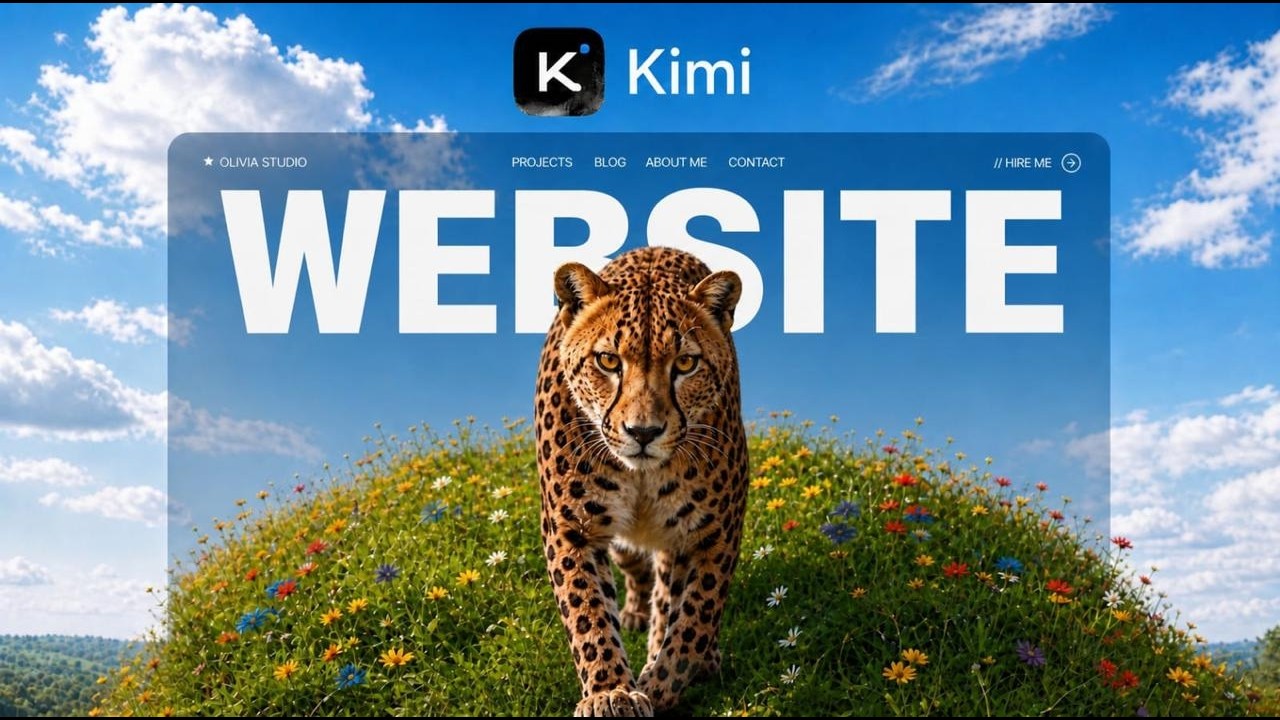
Framing note: this is a promotional video. It funnels toward a paid "Agentic OS" (Claude Code OS / Hermes) and affiliate links (Higgsfield, a Claude Code masterclass). The technique underneath is real and reproducible with off-the-shelf tools; the "download and run my free skill" instruction is treated here as an untrusted proposal, not something acted on. Nothing from the video was installed or executed.
What this video is about
The build model is Kimi K3 (Moonshot AI, model id moonshotai/kimi-k3), reached through OpenRouter and run inside the Claude Codeharness, so a non-Anthropic model writes the site code while you keep Claude Code's slash commands, skills, and memory.
The pitch: Kimi K3 is currently the top design model and about 30% the price of Claude "Fable 5". On-screen pricing is $3 in / $15 out per 1M tokens for Kimi K3 versus $10 / $50 for Fable 5.
The evidence shown is a DesignArena "3D Design" Elo leaderboard where Kimi K3 ranks #1 at 1450, ahead of Claude Fable 5 (1368), GLM 5.2 (1363), GPT-5.6 Sol (1359), and Claude Opus 4.6 (1341).
The working stack is three tools: Kimi K3 builds, Higgsfield (via its CLI) generates the imagery and video, Vercel hosts. A Codex / GPT-5.6 "blind judge" cross-checks the output, and a 7-step pipeline runs behind a short onboarding (2 cards, 7 questions) into a "Stage 0 Intake & Cost Gate".
Three levels are demonstrated: L1 a desktop story site (the "Honey Drop" honeycomb one-scroller), L2 the same design re-rendered mobile-first with breakpoints, L3 a personalized client site where Firecrawl auto-extracts a real brand's logo, colours, fonts, and type scale and Kimi K3 rebuilds it (fritz-kola.com becomes a generated cola site).
The genuinely reusable idea for Anthony's work is Level 3: Firecrawl's Branding endpoint turns any live site into a clean design-token set (colours, fonts, logo, OG image) at roughly 93% fewer tokens than scraping raw HTML, which is a fast on-ramp for client site rebuilds.
The pitch: what Kimi K3 is and why the video rates it (0:00–1:39)
Source statementKimi K3 (the speaker keeps saying "Kimikaze 3" / "Kimmy K3") is "the new number one" design model and the video promises sites that "look like the top 3%". The hook is that "97% of them look terrible" unless you give the model the right prompt (0:00).
Visual evidencethe concept is sold on a designed landing page (a site he built), not a neutral benchmark. It states the whole thesis in one frame: a $3 model that builds $20,000 websites, "2.8T params · open weights", "#1 Frontend Arena", "+ Higgsfield engine".
CaptionThe designed pitch page for the concept (localhost). It compresses the sell into three badges: 2.8T parameters/open weights, "#1 Frontend Arena", and a Higgsfield media engine. Source: 0:55
Source statementit is "around 30% the price of Fable 5" (1:30). The on-screen comparison gives the real numbers rather than a vibe.
CaptionCost per 1M tokens. Kimi K3 ($3 in / $15 out) is roughly 30% of Fable 5 ($10 in / $50 out) on both input and output. Source: 1:33
Inferencethe "#1 Frontend Arena" badge on the pitch page is a marketing restatement; the actual leaderboard evidence appears later (see the DesignArena board at 8:40, below). Keep the two separate.
The three levels (1:39–1:54)
Source statementthe whole video is structured as three levels of difficulty, "each level more important than the last" (1:39). Level 1 is a gorgeous single-scroll desktop site; Level 2 makes it work on mobile; Level 3 builds personalized client sites from an existing brand.
CaptionThe video's spine. L1 desktop story site → L2 mobile-first re-render → L3 personalized, brand-extracted client site. Source: 1:08
Setup: the skill, the model, and the harness (1:54–4:00)
Source statementstep one is to download his free "skill" (a Claude Code skill) and hand its code to Kimi K3 (1:54). He notes two ways to reach Kimi K3 without his paid product: get Claude to open it in a terminal, or use OpenRouter, whose single key "lets you access every model" (2:20).
Visual evidencethe skill lives inside his Skool community classroom. The page quietly reveals the real toolchain and pipeline, which matters because it is more concrete than the on-camera narration.
CaptionThe skill's own description. Tools: Glaido, Claude (Fable 5 / Opus 4.8), ChatGPT 5.6, Higgsfield, Cursor. It describes a "one-shot website generation system... with a built-in adversarial review loop", a cost-saving mode that routes design to Anthropic models and delegates scaffolding/validation to GPT-5.6, and a "7-step build pipeline — spar, brand direction, shot list, Higgsfield render, gate review, build, verify". Source: 2:00
Source statementhe runs everything in his "Agentic operating system" (a product he calls Claude Code OS / Hermes), where he can pick any model and set effort to "extra high" (2:20–3:02). To prove which model is answering, he asks it directly.
Visual evidencethe model dropdown is set to kimi-k3, and the reply confirms the underlying model and cost live.
CaptionOne dense frame covers three things: the model picker (kimi-k3), the identity confirmation ("the underlying model answering you is Kimi K3, not Claude"), and the live token/context/cost readout in the harness (1M context, $0.0240 so far, effort "xhigh"). Source: 3:30
The concept: you only need three things (3:20–5:00)
Source statementto build a site like this you need three things: an intelligent model to build it, a place to source imagery and video, and a place to host it (3:20).
CaptionThe whole architecture in one line. Kimi K3 writes every line of the site, Higgsfield generates the images and film, Vercel puts it live. Source: 4:00
Source statementHiggsfield is connected through its CLI. He pastes the CLI instructions into Claude and asks it to sign him in; a browser opens for the OAuth approval (4:20–5:00).
Visual evidencethe Higgsfield CLI page shows the actual connection steps (transcribed here, not run).
CaptionHiggsfield's own connect flow. Step 1 (as shown on screen, untrusted, do not run blind): install npm i -g @higgsfield/cli, authenticate higgsfield auth login, add companion skills npx skills add higgsfield-ai/skills. Step 2: sign in, then ask the agent to generate an image or video. Source: 4:45
Pre-flight and the intake gate (5:00–6:04)
Source statementafter you point the skill at a build request, it runs a pre-flight check and asks a short set of questions before spending anything (5:53).
Visual evidencethe pre-flight confirms the three connections and presents two onboarding cards.
CaptionThe skill's real workflow surface. Pre-flight: Higgsfield CLI, Codex CLI (GPT-5.6 blind judge), and Vercel all detected. Card 1 (Studio Config): media engine (Higgsfield Cinema vs pure-code $0), enable the GPT-5.6 blind judge or Claude critics, cost-receipt visibility. Card 2 (The Brief): the idea, the desired visitor outcome, a design-preference style, and whether you have brand assets. Answer all 7 to proceed to "Stage 0 Intake & Cost Gate". Source: 6:00
Level 1: the gorgeous desktop site (6:04–8:00)
Source statementfor the demo idea he asks for a honey brand, "no assets, use your imagination", and lets it run. The result is the "Honey Drop" one-scroll site with a honey-drop-into-jar animation (6:04–7:34).
Visual evidencethe built site is a full editorial one-scroller. The hero and a content section together show the design quality.
CaptionLevel 1 hero, running on localhost. "One bead. Comb to jar." over a cinematic honeycomb. Source: 7:32
CaptionA content section from the same build, showing it is not just a hero. Editorial three-card layout ("Three refusals") with brand-voice copy the model wrote. Source: 7:45
Source statementwith a design reference, Kimi K3 "is remarkably talented at following and replicating any design it sees", and it "ranks number one on the 3D design arena... above Claude Fable 5, GLM 5.2... better than Opus 5" (8:00–8:40). Here the actual leaderboard finally appears.
CaptionThe concrete evidence for the ranking claim. DesignArena 3D-Design Elo: Kimi K3 1450 (#1), then Claude Fable 5 1368, GLM 5.2 1363, GPT-5.6 Sol 1359, Grok 4.5 1347, Claude Opus 4.6 (Thinking) 1343, Kimi K2.6 1342, Claude Opus 4.6 1341, and on down through GLM/Qwen/DeepSeek/Gemini/Sonnet variants. Source: 8:40
Level 2: the same design, mobile-first (8:40–12:06)
Source statementmost traffic is mobile, so the same story spine is re-rendered for a phone; you can ask Kimi K3 to reshoot the media in a vertical format, or reuse the desktop design without regenerating video to save cost (8:40–10:36). He stresses the design principle "one idea per screen" and "same story spine".
Visual evidencethe mobile build is a portrait version of the honeycomb hero, shown next to the OS's own memory/knowledge-graph panel.
CaptionLevel 2. The same design re-flowed to a phone-width portrait layout, "one idea per screen". Source: 10:50
Source statementhe recommends resizing the browser to find the breakpoints and working with the model to tune them; even if you skip regenerating the video on mobile (to avoid the cost), you must still design for mobile because so many visitors arrive there (11:29–12:06).
Level 3: personalized client sites from a real brand (12:06–18:00)
Source statementthe money is in personalized sites, not generic ones. Clients already have an identity, palette, and vibe. Level 3 gives Kimi K3 one prompt to visit a site, extract the logo and brand identity, and build a matching (often 3D) site (12:06–13:37). His example brand is Fritz Cola.
Visual evidencethe source brand he points the pipeline at.
CaptionThe "before". The real fritz-kola.com, whose identity (black/white, editorial photography, Hamburg heritage) the pipeline will extract and rebuild. Source: 13:55
Source statementthe key step he tells you not to skip is using Firecrawl to extract brand identity, because asking a model to scrape pages "spins in circles" and Kimi K3 has a real per-call cost; Firecrawl returns crisp brand data without the useless HTML (14:30–15:40, 15:40–16:00).
Visual evidenceFirecrawl's Branding output is the mechanism that makes Level 3 fast.
CaptionThe reusable idea. Firecrawl's Branding endpoint returns a clean design-token set (logo, favicon, OG image, colour hexes, font family, full type scale, spacing) from a live URL, at roughly 93% fewer tokens than raw HTML. This is what Kimi K3 then builds against. Source: 15:40
Source statementif the model misbehaves mid-build you can ask Claude Code itself to interface with it and unblock you, and he "builds every mistake back into the skill so it never happens again" (16:00–17:00). The finished Fritz site comes back auto-branded.
CaptionThe Level 3 output. A generated cola site carrying Fritz's black/white identity and heritage line, "two friends. one idea." Note the visible placeholder ("lorem") copy, i.e. a first-pass draft, not finished. Source: 17:45
Hosting on Vercel (18:00–18:30)
Source statementhosting is Vercel. You create an account and tell Claude "connect to Vercel via the CLI"; it opens a browser, you sign in, and the agent can deploy on your behalf (18:09).
CaptionWhere the sites land. A Vercel Pro account with many deployed projects (stacked-daily, pulp-press, glaido-deck, and more), each on a .vercel.app URL. Source: 18:15
Tools and resources
Tool / product
Role in the workflow
Notes
Kimi K3 (Moonshot AI)
The model that writes the site code
model id moonshotai/kimi-k3; open weights, 2.8T params per the pitch page; reached via OpenRouter
OpenRouter
Single API key to reach Kimi K3 (and other models)
The no-paid-product path the video points to
Claude Code
The harness Kimi K3 runs inside
Keeps slash commands, skills, memory while a non-Anthropic model answers
Claude Code OS / Hermes ("Agentic OS")
The speaker's paid product wrapping the above
Model picker, effort control, memory/knowledge graph, cost readout
Higgsfield (+ Higgsfield CLI)
Generates images and video for the sites
Connected via CLI; npm i -g @higgsfield/cli, higgsfield auth login
Codex / GPT-5.6
"Blind judge" that cross-checks the build
Optional; Claude critics can substitute
Firecrawl
Extracts brand identity (logo, colours, fonts, type) from a live URL
The Branding endpoint; ~93% fewer tokens than raw HTML
Vercel
Hosting / deploy
Connect via CLI; agent deploys on your behalf
DesignArena
The benchmark cited for the #1 design claim
3D-Design Elo board shown at 8:40
Claims to verify
Kimi K3 is #1 for design. Shown via a DesignArena 3D-Design Elo board (Kimi K3 1450). This is one arena, one category (3D design), sourced from Moonshot's own LinkedIn post. Date- and version-sensitive; leaderboards move constantly (the speaker himself says the ranking "changes more often than Game of Thrones").
~30% the price of Fable 5. On-screen: $3/$15 vs $10/$50 per 1M tokens. Consistent internally, but verify current OpenRouter pricing before relying on it.
Kimi K3 cost is "same ballpark as Opus 5". Spoken at 15:00, in tension with the "$3 model" framing; the honest read is that per-call cost is non-trivial once media generation and long context are involved.
"2.8T params · open weights". From the pitch page (marketing surface), not an independent source; verify against Moonshot's model card.
"Builds $20,000 websites". Marketing claim; the on-screen results are first-pass drafts (visible placeholder copy on the Fritz build).
Glossary
Kimi K3: Moonshot AI's large language model (model id moonshotai/kimi-k3), pitched here as a top model for front-end/website design. The speaker mispronounces it as "Kimikaze 3" / "Kimmy K3".
Moonshot AI: The company behind the Kimi family of models.
OpenRouter: A service that gives you one API key and one endpoint to call many different AI models from different providers, with routing and fallbacks.
Claude Code: Anthropic's command-line coding agent (a "harness") that runs an AI model with tools, slash commands, skills, and memory. Here it hosts a non-Anthropic model.
Harness: The surrounding program that runs a model and gives it tools, context, and commands. Swapping the model inside a harness keeps the harness's features.
Agentic OS / Claude Code OS / Hermes: The speaker's paid product that wraps Claude Code with a model picker, memory/knowledge graph, cost display, and agents.
Skill: A packaged set of instructions (a Claude Code skill) that tells the agent how to run a particular workflow, here the website-building pipeline.
Higgsfield: An AI media platform that generates images and video from prompts, with access to models like Seedance, Veo, Kling, and Nano Banana. Connected here through its CLI.
CLI (command-line interface): A text-command way to drive a tool from the terminal, as opposed to clicking in a web app.
Firecrawl: A scraping/extraction service that turns a web page into clean, model-ready data. Its Branding endpoint returns a site's design tokens (logo, colours, fonts, type scale).
Design token: A single reusable design value (a colour hex, a font family, a spacing unit) that defines part of a brand's visual system.
Vercel: A hosting platform that deploys web projects and serves them on the internet, each on a URL.
DesignArena: A benchmark where people blind-test AI models' design output and the results are scored into a leaderboard.
Elo rating: A numeric score (borrowed from chess) that ranks competitors from head-to-head results; higher is better.
Blind judge / adversarial review loop: A second model that critiques or scores the first model's output without knowing which is which, to catch weak work before it ships.
Breakpoint: A screen-width threshold in responsive design where the layout changes (for example, switching from a desktop layout to a mobile one).
One-scroll / one-scroller: A site that tells its whole story on a single scrolling page rather than across many linked pages.
OG image: The preview image (Open Graph) a site shows when its link is shared on social platforms.
Personal recommendations
These are proposals for Anthony to accept or reject. Nothing here was created or routed; the video's own "download my skill" instruction was not acted on.
1
Firecrawl brand extraction for Alexana/client site builds
Firecrawl's Branding endpoint returned a clean design-token set (logo, favicon, OG image, colour hexes, font family, full type scale, spacing, tone) from a live URL, at ~93% fewer tokens than raw HTML.
System value
For any client site rebuild or clone, this is a fast, cheap way to lift an existing brand's visual system into a design brief without hand-auditing CSS. It fits the existing /site-clone and impeccable build flows.
Proposed form
Reference note in the website-build toolkit (a "extract brand tokens with Firecrawl first" step), and a candidate pre-approved Firecrawl use inside a build skill.
Kimi K3 at $3/$15 per 1M tokens (vs Fable 5 $10/$50) produced high-craft one-scroll marketing sites, and topped a 3D-design arena.
System value
A cheaper model for first-pass design/scaffolding could cut cost on exploratory site builds, with a stronger model reserved for finishing. Runs inside Claude Code via OpenRouter, so it slots into existing tooling.
Proposed form
A time-boxed evaluation (one real site build, Kimi K3 draft then Opus/Fable finish) before adopting anything.
Target project
website-build tooling / a build-journal preflight experiment.
the skill runs a Codex/GPT-5.6 "blind judge" and a 7-step pipeline (spar, brand direction, shot list, render, gate review, build, verify) behind a 2-card / 7-question intake and a "Stage 0 cost gate".
System value
The intake-then-cost-gate-then-adversarial-review shape mirrors Anthony's orchestrate and impeccable gates; the explicit cost gate before spend is a clean guardrail worth borrowing.
Proposed form
A note comparing this 7-step pipeline to the existing orchestrate/impeccable flow, flagging the pre-spend cost gate as a possible addition.
Target project
fleet-control / orchestrate-flow and impeccable-pipeline.
Take this with you
Save the playbook to read later, or hand the raw notes to your favorite AI.
What's this?
The Markdown file (a .md file) is a plain-text copy of this whole playbook, written in the simple format AI chat tools read best. It keeps the headings, links, timestamps, and captions and drops all the page styling. Think of it as the raw notes behind this page, ready to hand to an assistant.
To use it, download the file and drag it into ChatGPT, Claude, or any AI chat (or just paste the text in), then ask for what you want: “Summarize this into a one-page cheat sheet,” “Turn these steps into a checklist I can follow,” or “Quiz me on the key ideas.” Because the file is already structured, the assistant works from the real content instead of guessing.