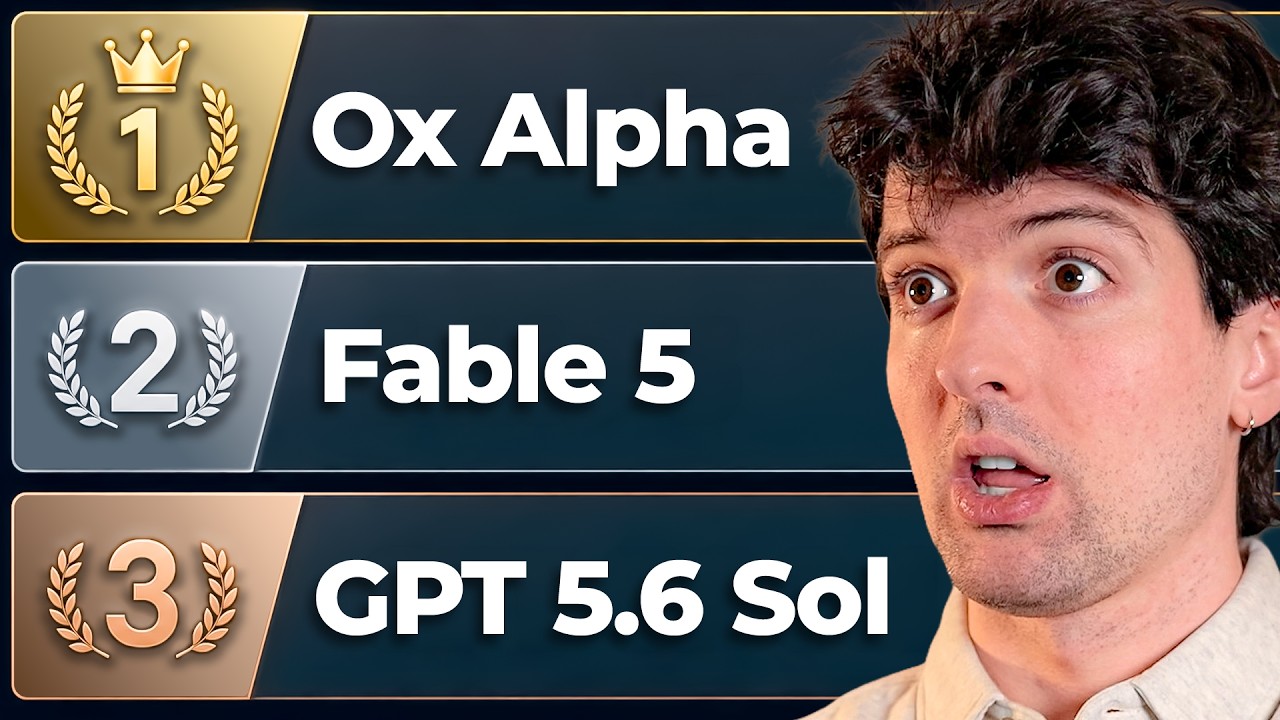
Theo Browne walks through a week of heavy real-world use of a model that dropped anonymously as Ox Alpha and turned out to be GLM 5.3 Flash from the Chinese lab Z.ai. His thesis: it is not a smart model, but it is the first small, cheap model that is genuinely pleasant to do agentic work with, because it behaves, and that forces a cleaner way to think about what makes a model useful.
What this video is about
Ox Alpha was GLM 5.3 Flash all along. A model dropped anonymously and free for a week on OpenCode and OpenRouter, immediately became the #1 model on OpenRouter (23.2T tokens, 2.3x the next model), and turned out to be a flash model that behaves near Opus 4.8 on agentic work at a tenth to a hundredth of the price. (source)
Separate intelligence from behavior. Intelligence is baked-in knowledge; behavior is agentic capability: staying on task, accepting mid-task steering, and unblocking itself. GPT 4.5 was pure intelligence and useless agentically; Gemini 3.1 Pro is brilliant yet a bad coder. GLM 5.3 Flash is the rare case of "genuinely stupid but genuinely awesome to work with." (source)
Behavior comes from hard RL in provisioned environments. Z.ai post-trained the model to do real work in real sandboxes, so it does what you tell it, remembers a new instruction inserted halfway through, and recovers from its own failures instead of stopping. (source)
Absurd economics. 320B total / 18B active params (a tenth the size of Kimi K3), 1M context, priced ~$0.075 in / $0.25 out per million tokens with a 50% discount, and it does not get more expensive as your context fills. Auditing 1000+ PRs across the T3 Code repo cost ~12 cents. (source)
Full multimodality is the moat over DeepSeek V4 Flash. It takes image, audio, and video (V4 Flash has no downloadable vision), which is why Theo now uses it for the one-off, vision-needing, long-running tasks he used to give V4 Flash. (source)
It runs entirely on Huawei Ascend chips, not Nvidia. Serving it on banned-from-the-US Chinese silicon (Ascend 910B/C) is a large part of why they could give away so many tokens for free. (source)
---
1. The anonymous drop and the misleading numbers (00:00-01:31)
A model appeared anonymously under the name Ox Alpha, announced by OpenCode and OpenRouter, with one detail that made Theo pay attention: a stated capacity of 100 trillion tokens per day. For scale, he burns ~7B tokens on his heaviest day, and all of Google's Gemini traffic is estimated around 150T tokens/day. Giving that away free implied either a hidden compute reserve or a very small, cheap model.
The anonymous launch post: "Ox Alpha (stealth model) is free for the next week" with 1M context, multi-modal, zero data retention, and capacity for 100T tokens/day. (0:58)
Early numbers stoked the hype. Ben Davis benched it against a public subset of DeepSWE problems, where it scored far above the field. Theo flags upfront that these numbers are misleading (a small public subset, not the real closed score), but insists it does not make the model bad.
Early word-of-mouth benchmark on a 10-task DeepSWE subset: the mystery model landed near 80% while gpt-5.6-sol got 52% and fable 65%. A tiny subset, so treat as a signal, not a score. (1:45)
2. The reveal: it is a flash model (01:31-03:02)
The mystery model is GLM 5.3 Flash. Theo's headline framing: it behaves better than plain 5.3 and roughly on par with Opus 4.8 on agentic tasks, at a tenth to a hundredth the price. He got it running inside his codex/Claude Code proxy layer (T3 Code) via an OpenRouter binding.
GLM 5.3 Flash wired into codex (OpenAI Codex v0.150.0) through Theo's proxy, running as the active model in T3 Code. (4:40)
3. Real agentic test: auditing every open PR (03:02-09:07)
Theo's first task for any new model: point it at work he already has. He asked it to review all open PRs in the repo and prioritize by ease of merge and user value, then mid-task steered it twice, first to ignore Codex-authored PRs and only review Fable-authored ones, then to put its findings in HTML so he could read them on his phone. Two behaviors stood out:
It took mid-task steering without derailing (many models respond to a redirect by prematurely stopping or losing the original task).
When it spun up six sub-agents and three failed on provider auth errors, it noticed the pattern and fell back to auditing directly rather than waiting on broken delegation.
The self-unblocking moment: the model detected that sub-agent delegation kept failing, abandoned it, and completed the whole PR audit directly. Theo calls this "debugging its own flows." (7:46)
In an earlier run (5 days prior) the same prompt audited every PR updated in the last 5 days (hundreds of them) in ~20 minutes, produced a ranked report with real clickable PR links (a small thing most frontier models get wrong), and surfaced eight easy merges Theo went and merged.
4. Cost of the audit: rounding to zero (09:07-11:31, 20:43-22:30)
Theo asked the model to count its own token usage and price the run. Rough first math came to ~50 cents to audit all 1000+ open PRs; a Fable run of just his own PRs had cost over $100. After correcting for cached-token pricing (cache reads are only 1.5 cents/M), the true cost was ~12 cents.
The corrected cost of auditing the entire repo's open PRs: 12.06 cents, the vast majority of the 6B input tokens served from cache. (24:35)
The reason it can be this cheapit is small. 320B total parameters, just 18B active per expert, versus Kimi K3's 3 trillion. A tenth the size, comparable behavior. Theo plans to set up a bot that runs the PR audit every 3 hours.
5. Intelligence vs behavior: the core framework (11:31-17:43)
Theo's central idea. Model capability collapses badly if you think of it as one axis or as dozens of task-specific axes. He proposes two:
Intelligence = how much knowledge is baked in. GPT 4.5 (rumored ~10T params) was hugely knowledgeable but slow, not a reasoning model, and useless for agentic dev. Gemini 3.1 Pro is the most intelligent model on his knowledge-heavy "Skatebench" (95-97%, the only model in the 90s) yet a poor coder: told to fix code it reasons itself into rebuilding the whole codebase.
Behavior = how well a model applies what it is told. This is really agentic capability: does it stay on task, accept new instructions mid-flow, unblock itself, and avoid going off the rails?
The ideal is both. Fable and gpt-5.6-sol have both (Fable leans intelligence with slightly worse behavior; sol is "RLed to hell" to stay on task aggressively). What had never happened before, Theo says, is a model that is genuinely stupid but genuinely great to work with, and GLM 5.3 Flash is exactly that.
6. Why behavior beats raw smarts for agents (17:43-24:01)
Behavior comes from how hard Z.ai reinforcement-trained the model in provisioned environments (real sandboxes where the model does real work and learns to work better). The payoff is the "does what you told it" moment: Theo told it to review all PRs, then narrowed to Fable-only, and briefly suspected it had gone rogue when it surfaced non-Fable PRs, before realizing his own first instruction had said "all." The model had simply obeyed literally.
He confirmed vision live by screenshotting a cost table and pasting it into the thread; the model read it and reasoned about it. That vision capability is the wedge over DeepSeek V4 Flash, which he used to reach for on one-off and long-running tasks but which has no downloadable vision and tends to get lost on longer work.
7. The official numbers and architecture (24:01-27:59)
Z.ai's own launch post, "Frontier Intelligence at Flash cost," confirmed the details and made the case for the anonymous drop: releasing it free as Ox Alpha got people to try it, then be impressed once they knew nothing about it.
The official intro confirms the core specs: first natively multimodal model in the GLM-5 series, 320B/18B params, hybrid sparse + linear attention to cut long-context serving cost, a 30T-token multimodal pre-training corpus, and "all traffic served on Chinese AI chips." (26:15)
During the free week ox-alpha processed 23.2 trillion tokens on OpenRouter, 2.3x the next model (deepseek-v4-flash at 9.9T). Free plus good equals dominant. (25:40)
Two consequences of the architecture worth pulling out: the hybrid sparse + linear attention means the price does not rise as your context window fills, and the 30T-token multimodal corpus is what enables image, audio, and video input, not just image recognition.
8. Pricing, speed, and benchmarks (10:38-11:31, 24:01-31:11)
On OpenRouter the model is served by many providers. Z.ai offers a 50% discount (~$0.075 in / $0.25 out per million tokens), and providers like Baseten hit ~114 tokens/second. Latency spiked during the free-for-all but is expected to recover as hosting spreads.
Provider spread on OpenRouter: multiple hosts, Z.ai/Novita/GMICloud at 50% off ($0.075 in / $0.25 out), Baseten leading throughput at 114 tps. (10:40)
The model page: "native multimodal model from Z.ai... suited for efficient coding and long-horizon agent tasks," 1M context, released Aug 26 2026. (11:40)
On Z.ai's own Code Bench, Theo highlights the effort-level chart: GLM 5.3 Flash on high nearly matches its own max score while spending under half the tokens, and lands near Opus 4.8, at under a tenth the price.
Accuracy vs output tokens by effort level. GLM 5.3 Flash (purple) does the same work at ~70k tokens that Opus 4.8 needs ~120k for, and its high setting is close to its max. (28:05)
The one real complainttoken efficiency. On Artificial Analysis it averaged ~47k tokens/task versus Luna's 20k and sol's 17k. Not the worst for a flash model, but more tokens means slower completion and faster context bloat. Theo expects efficiency to improve now that the strong base exists.
Output tokens per task across the field. GLM 5.3 Flash uses meaningfully more tokens than the most efficient models, the main knock against it. (31:15)
9. Design, copy, and creative work (31:11-37:14)
Theo runs the model through Dar's design bench (which builds pages from prompts). Out of the box the output is mediocre, but with a design or "taste" skill applied it produces surprisingly good pages, including a scroll effect where cards cover each other, and copy that "doesn't read like usual AI-generated slop."
Design-scale output. Bold, template-flavored, but coherent layout and legible hierarchy. (32:45)
Taste-scale output. Restrained typography and an index-card metaphor, closer to hand-designed. (33:05)
Taste-scale output with notably human-sounding copy ("a private network of notes that gets smarter the more you think"). (34:15)
It also builds playable things. Theo's "fish slop" game feels solid to move around and animates well, though it has logic bugs (fish stop moving after eating, eat when not hungry): the pattern of a not-smart model getting the small details right.
"Fish slop": logic bugs, but the animation ordering and feel are surprisingly good for a 20-cent-per-million-out model. (34:35)
Where Theo was most impressed: given a Blender scene, the model built a full, realistic 3D restaurant environment over 12 hours. (36:40)
10. The hardware secret: Huawei Ascend (37:14-38:44)
The final hookthe other reason they could serve this so cheaply is that it runs entirely on Chinese AI chips, the Huawei Ascend 910B/C (SMIC 7nm), with no Nvidia in the pipeline. The chips have memory constraints, so the model is heavily optimized, probably at the cost of throughput.
The hardware detail: Huawei (largely US-banned) manufacturing capable AI chips and Z.ai serving a frontier-adjacent model on them without Nvidia is, in Theo's words, "truly crazy." (37:25)
11. Tier-list placement and wrap (38:44-42:28)
Theo's tier list ranks unique value, not raw smarts. GLM 5.3 Flash is not smarter than Kimi K3 or Opus 5, but it earns a spot next to sol because of what it uniquely enables: cheap, private (run it yourself), vision-capable, well-behaved agentic work. He moves DeepSeek V4 Flash down a tier, arguing there is now no reason to use it over GLM 5.3 Flash.
Final placement: GLM 5.3 Flash sits in B alongside the frontier-adjacent models it competes with on value, having pushed DeepSeek V4 Flash down. (40:20)
His closing linewith Fable, sol, and GLM 5.3 Flash, there is practically zero reason to reach for anything else. If you want something absurdly cheap, surprisingly capable, thorough, and well-behaved, this is worth trying.
Tools and resources
Item
What it is
Reference
GLM 5.3 Flash
Z.ai's open-weight, natively multimodal flash model (aka Ox Alpha); 320B total / 18B active, 1M context
Pricing "$0.075 in / $0.25 out per million tokens" is the discounted (50% off) Z.ai rate through Sep 9 2026; list price is ~$0.15/$0.50. Verify current rate before relying on it. (11:40)
"320B total / 18B active params" and "30T-token multimodal corpus" come from Z.ai's own launch post, not an independent source. (26:15)
The ~12-cent audit cost depended heavily on cache hits (6B input tokens, mostly cached); an un-cached run would cost more. (24:35)
DeepSWE "80%" early number is on a small public subset, explicitly flagged as misleading; the closed/full score differs. (1:45)
"Runs entirely on Huawei Ascend chips" originates from a single researcher's X post plus the vendor's phrasing "Chinese AI chips"; not independently confirmed hardware detail. (37:25)
Model/version names (Opus 4.8, Opus 5, Fable 5, gpt-5.6-sol/luna/terra, Gemini 3.1 Pro, Kimi K3, Muse Spark, DeepSeek V4 Flash) are as spoken and may be mis-transcribed.
Glossary
GLM 5.3 Flash: Z.ai's open-weight, natively multimodal "flash" (small, fast, cheap) model; the subject of this video.
Ox Alpha: the anonymous code name GLM 5.3 Flash was released under for a free early-access week.
flash model: a deliberately small, fast, cheap model class, traded against raw intelligence.
open weight: the model's trained parameters are downloadable, so anyone can self-host it (distinct from open source, which would also include training code/data).
multimodal: able to take more than text as input; here image, audio, and video.
active parameters: in a mixture-of-experts model, the subset of total parameters actually used per token (here 18B of 320B), which sets the real compute cost.
mixture of experts (MoE): an architecture that routes each token to a small "expert" sub-network, so a large total model runs at the cost of its active slice.
context window: the maximum amount of text/tokens a model can consider at once (here 1M tokens).
reinforcement learning (RL): post-training that rewards desired behavior; "RLed" means heavily trained this way to shape how a model acts.
provisioned environments: real sandboxed systems the model is trained inside so it learns to do actual work, credited here for the model's good agentic behavior.
agentic work: multi-step tasks where the model uses tools, runs commands, and self-directs, rather than answering a single prompt.
behavior (Theo's sense): a model's agentic capability, staying on task, taking mid-task steering, and unblocking itself, as opposed to raw knowledge.
intelligence (Theo's sense): the amount of knowledge baked into a model, as opposed to how well it applies instructions.
steering: giving a model a new or changed instruction partway through a task.
sub-agents: helper agents an orchestrating model spawns to parallelize a task; here several failed and the model fell back to direct work.
harness: the tooling and scaffolding around a model (tool use, retries, environment) that turns raw intelligence into usable capability.
computer use: a mode where the model controls a computer/GUI directly (screenshots, clicks) rather than only emitting text.
hybrid sparse + linear attention: an attention design mixing sparse and linear mechanisms to keep long-context serving cheap; here it also keeps price flat as context grows.
token efficiency: how few tokens a model needs to finish a task; fewer means faster completion and less context bloat.
tokens per second (TPS): model output speed; Baseten hit ~114 tps here.
time to first token (TTFT): latency before the first output token appears.
cached tokens / cache reads: repeated input served from a cache at a steep discount (here 1.5 cents/M), which made the audit ~12 cents.
Pareto frontier: the cost-vs-intelligence trade-off curve; a model "crushing the frontier" delivers more intelligence per dollar than anything at its price.
DeepSWE: a software-engineering benchmark; the early hype number was on a small public subset of it.
Artificial Analysis Intelligence Index: a third-party aggregate score used to compare model intelligence and token use.
Huawei Ascend 910B/C: Chinese AI accelerator chips (SMIC 7nm) the model is served on, instead of Nvidia.
OpenRouter: a marketplace/router that sends a request to one of several hosting providers based on price, speed, or tool-calling accuracy.
OpenCode: an open-source coding agent, co-announcer of the anonymous drop.
Z.ai (ZAI): the Chinese AI lab behind the GLM model family.
Personal recommendations
1
Benchmark GLM 5.3 Flash as a cheaper vision model for the /yt pipeline
GLM 5.3 Flash is natively multimodal (image/audio/video) at ~$0.075 in / $0.25 out per million tokens (50% off), open weight, and Theo confirmed working vision live by pasting a screenshot for analysis.
System value
the /yt pipeline's Phase 2 discovery sweep and Phase 3 frame verification currently run on openai/gpt-5.6-luna (~$0.10/$0.60 per M). A vision model at a fraction of the output price, with a 1M window, could cut per-video vision cost, and the same swap would flow to Alexana Essence's ingestion pipeline. Anthony fixed the luna default "in stone," so this is an evaluation to inform him, not a swap to make.
Proposed form
a head-to-head in yt-pipeline-experiments (same 320px batches, same frames) scoring GLM 5.3 Flash vs gpt-5.6-luna on description accuracy, format compliance, and cost per source-hour; a findings note, no default change.
Target project
yt-pipeline-experiments / learning.
2
Test GLM 5.3 Flash against DeepSeek V4 Flash as the /yt prose + extraction drafter
Theo argues GLM 5.3 Flash replaces DeepSeek V4 Flash for one-off and long-running tasks because V4 Flash has no downloadable vision and gets lost on longer work, while GLM 5.3 Flash stays on task.
System value
the fleet's standing prose/extraction drafter is deepseek/deepseek-v4-flash-0731. If a comparably cheap model holds format compliance better on long drafting and adds vision, it is worth knowing before the next stress test; the same default powers Essence.
Proposed form
a drafting-contract comparison in yt-pipeline-experiments on the existing playbook/lesson format contract (prose survival %, format-compliance %, cost), reported as evidence only.
Target project
yt-pipeline-experiments.
3
Codify "intelligence vs behavior" as an explicit fleet model-routing heuristic
Theo splits model capability into intelligence (baked-in knowledge) and behavior (agentic: stays on task, takes steering, self-unblocks), and argues behavior often matters more for real work.
System value
the fleet's INS-26 routing already sends strong reasoning to contracts/gates and cheap models to bulk drafting. Naming the axis "behavior = agentic capability" and writing down which lane each task needs gives a crisp, teachable rule for the openrouter routing doc.
Proposed form
a short addition to the openrouter tool-module / routing reference framing task assignment around the intelligence-vs-behavior split.
Target project
fleet-control.
4
A scheduled "audit my open PRs, rank by ease of merge, output HTML" bot
Theo built exactly this (audit all open PRs, rank by ease/value, emit clickable-link HTML) for ~12 cents and plans to run it every 3 hours.
System value
Anthony maintains several active repos (learning-library, fleet-control, open-house-lead-gen-course). A cheap recurring PR-triage that surfaces easy merges as a mobile-readable page fits the existing scheduled-job + digest surfaces, and a behaves-well cheap model makes it near-free.
Proposed form
a proposal note for a scheduled triage job (reuse the automated-jobs inventory + a digest hook), gated on Anthony's go.
Target project
fleet-control / alexana-workspace.
5
Adopt the self-unblocking fallback pattern in fleet mission actuators
when its sub-agents kept failing on provider auth errors, the model detected the repeated failure and fell back to doing the work directly instead of stalling.
System value
fleet missions that fan out to child agents can hang when children fail systematically. A "detect repeated child failure, fall back to inline execution or stop-and-report" rule is a concrete resilience pattern matching how this mission's own guardrails already think about stalls.
Proposed form
a design note for the mission actuator's failure-handling (detect N consecutive child failures, degrade to inline or surface a HANDOFF blocker).
Target project
fleet-control.
Take this with you
Save the playbook to read later, or hand the raw notes to your favorite AI.
What's this?
The Markdown file (a .md file) is a plain-text copy of this whole playbook, written in the simple format AI chat tools read best. It keeps the headings, links, timestamps, and captions and drops all the page styling. Think of it as the raw notes behind this page, ready to hand to an assistant.
To use it, download the file and drag it into ChatGPT, Claude, or any AI chat (or just paste the text in), then ask for what you want: “Summarize this into a one-page cheat sheet,” “Turn these steps into a checklist I can follow,” or “Quiz me on the key ideas.” Because the file is already structured, the assistant works from the real content instead of guessing.