Video learning playbook
Rolling a big cigar outside - Churchill
What this video is about
- A premium cigar is three leaves doing three jobs: filler (the blended core, most of the flavour), binder (holds the core together, steadies the burn), and wrapper (the outer leaf, its face and up to 60% of perceived flavour).
- The video shows the full hand-roll top-down: selecting long-filler leaves, bunching them with open air channels, pressing the bunch in a mold, spiralling on the maduro wrapper with a chaveta, and sealing the head with a cap.
- The specific cigar is a 7x47 Churchill: Brazilian binder, Nicaraguan filler, Ecuadorian maduro wrapper (per the video description). "Churchill" is the vitola (size), not a topic.
- Ring gauge is the diameter in 64ths of an inch, so 47 = 47/64 inch; a Churchill burns a slow 60 to 90 minutes. Maduro means "ripe", a darker, longer-fermented, sweeter wrapper.
- No implementation candidates for Anthony's business: this is a craft/hobby source, so the interactive lesson deliberately omits the "for your system" section.
1. Three leaves, one cigar
A cigar is filler, binder, and wrapper, assembled by hand. Filler is the core blend and the main flavour source; binder encases the filler and gives a smooth even burn; the wrapper is the outer leaf you see and taste first.
Visual evidencewhole long-filler leaves fanned out, the chaveta blade at the ready. 2:10
2. Bunching the filler
The roller folds several long-filler leaves into a bunch, leaving air channels down the middle so smoke can travel through. Too tight plugs the draw; too loose burns hot. Named methods (entubar, accordion bunching) exist to protect those airways.
Visual evidencefolding the filler into a bunch by hand, channels kept open down the centre. 0:30
3. The binder and the press
The filler is wrapped in a binder leaf (filler plus binder = the bunch), which governs burn and structure more than the wrapper does. The bunch goes into a wooden mold to set its shape. Factory presses run 15 to 30 minutes; the video description says this one sat in the mold about five hours (bunched in the morning, wrapped in the afternoon).
Visual evidenceworking the bunch firm and straight before wrapping. 4:20
4. Applying the wrapper
The wrapper is the outer leaf and can account for 60% or more of perceived flavour, so it gets the most attention in growing and fermentation. This one is an Ecuadorian maduro (darker, longer-fermented, richer, a touch sweet). The roller cuts it on a curve with the chaveta and spirals it up the bunch from the foot, stretching gently for a smooth, gap-free finish.
Visual evidencethe maduro wrapper spiralling up the bunch from the foot; the leaf it is cut from lies alongside. 6:40
5. The cap and the finished cigar
The head is sealed with a cap, a small round piece of wrapper leaf glued with flavourless vegetable gum. When cutting a cigar you cut the cap but never below its shoulder seam, or the wrapper unravels. The open foot is what you light. The result is one finished, straight-sided (parejo) cigar.
Visual evidencesealing the head with a cap; the pot of vegetable-gum glue sits top-left. 10:20
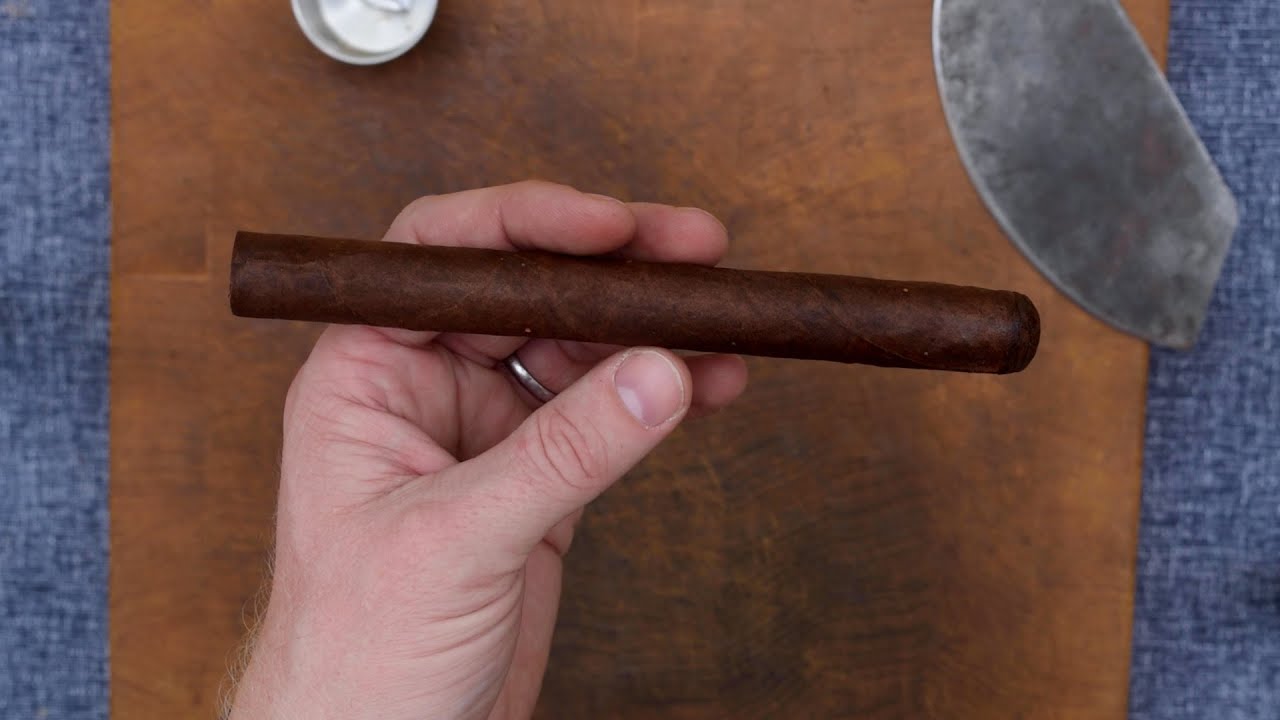
Visual evidencethe completed cigar, smooth wrapper, firm body, sealed head. 9:00
6. Why it is called a Churchill
Cigars are named by vitola (size and shape): length in inches and ring gauge (diameter in 64ths of an inch). A Churchill is 7 x 47, named after Winston Churchill, a slow 60-to-90-minute smoke. This one is a straight-sided parejo; shaped ones (torpedoes, pointed feet) are figurados. Its dark skin is the maduro wrapper.
Tools and resources
| Item | What it is | Reference |
|---|---|---|
| Chaveta | The roller's flat, rounded, very sharp blade for cutting leaf | cigar references |
| Mold / press | Wooden form that sets the bunch's shape | cigar references |
| Vegetable gum | Flavourless glue that seals the cap | cigar references |
| Interactive lesson | The deployed teaching edition of this package | https://cigar-rolling-lesson.vercel.app |
Claims to verify
- Wrapper "up to 60% or more of perceived flavour": stated by Holt's; a common industry figure, treat as a rule of thumb not a measured constant.
- The five-hour mold time and the specific leaf origins (Brazilian binder, Nicaraguan filler, Ecuadorian maduro) come from the video's own description, not independently verified.
- Press times (15 to 30 minutes for factory bunches) vary by maker; the range is typical, not universal.
Glossary
- Wrapper: the outer leaf; the cigar's face and a large share of its flavour.
- Binder: the leaf under the wrapper that encases the filler and steadies the burn.
- Filler: the blended core tobaccos; the main flavour source; its density sets the draw.
- Long-filler: whole full-length leaves (premium), versus chopped short-filler (machine-made).
- Bunch: filler wrapped in binder, before the wrapper goes on.
- Draw: how easily air pulls through the cigar; set by how densely the filler is bunched.
- Entubar / accordion bunching: named ways of folding filler that protect the central airways.
- Mold / press: the form that sets the bunch's final shape and firmness.
- Chaveta: the roller's flat, rounded, very sharp cutting blade.
- Cap: the small round wrapper piece sealing the head; cut it, but not below its shoulder.
- Head / foot: the end you cut and smoke / the open end you light.
- Vitola: a cigar's size-and-shape name (length x ring gauge).
- Ring gauge: diameter in 64ths of an inch (47 = 47/64 inch).
- Churchill: the 7 x 47 vitola, a slow 60-to-90-minute smoke.
- Parejo / figurado: a straight-sided cigar / any shaped (non-cylinder) cigar.
- Maduro: "ripe" in Spanish; a darker, longer-fermented, sweeter wrapper.
- Fermentation: controlled sweating of tobacco that develops colour and flavour; longer makes darker maduro leaf.
Sources
- Holt's Cigar Company, "Cigar Anatomy: Parts of a Cigar" (wrapper ~60% of flavour, binder, cap, foot).
- Cigar Aficionado, "Cigar Shapes, Sizes and Colors" (ring gauge in 64ths, Churchill 7 x 47, maduro).
- Famous Smoke Shop / Cigar Advisor, "How Cigars Are Rolled" (bunching, pressing, wrapping).
- Cigar Chief, "Torcedores: The Cigar Rolling Process" and "Wrappers, Binders & Fillers Explained".
- La Aurora, "The Cigar Roller" (the torcedor's craft).
Personal recommendations
None. This is a craft/hobby source with no application to Anthony's business or systems, so the interactive lesson omits the "for your system" section by design.
Take this with you
Save the playbook to read later, or hand the raw notes to your favorite AI.
What's this?
The Markdown file (a .md file) is a plain-text copy of this whole playbook, written in the simple format AI chat tools read best. It keeps the headings, links, timestamps, and captions and drops all the page styling. Think of it as the raw notes behind this page, ready to hand to an assistant.
To use it, download the file and drag it into ChatGPT, Claude, or any AI chat (or just paste the text in), then ask for what you want: “Summarize this into a one-page cheat sheet,” “Turn these steps into a checklist I can follow,” or “Quiz me on the key ideas.” Because the file is already structured, the assistant works from the real content instead of guessing.