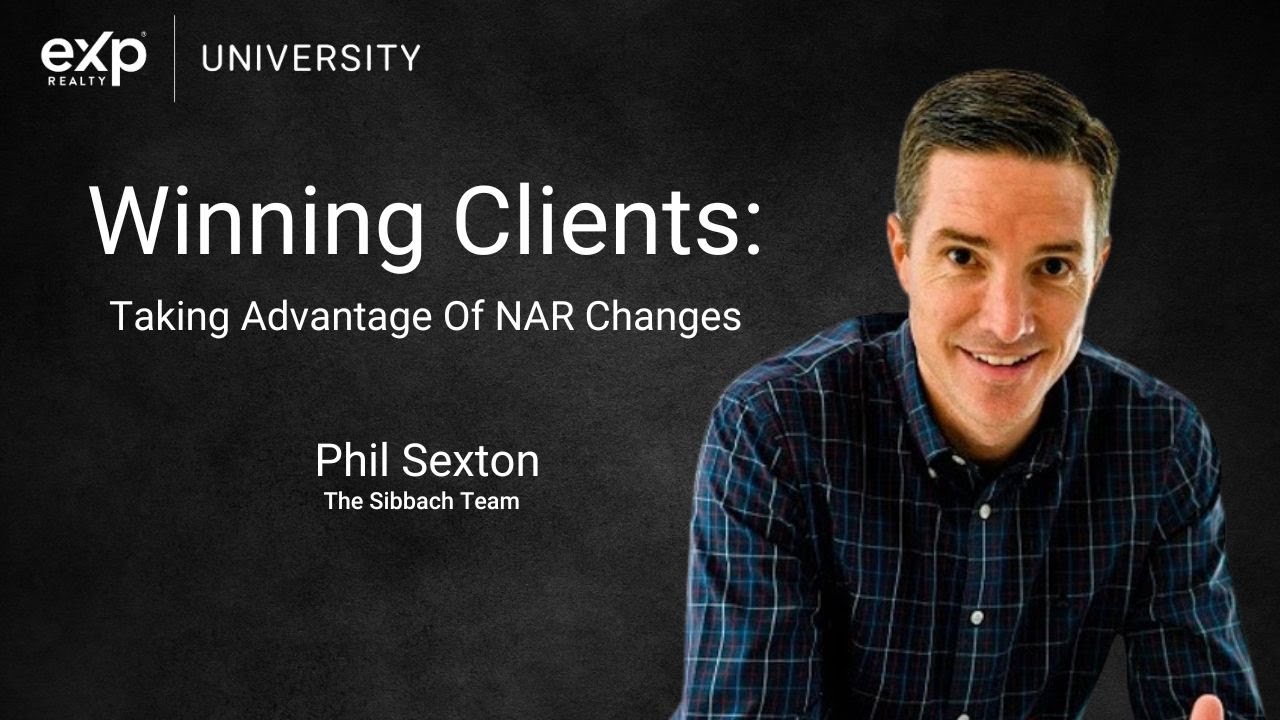
Source statement: after the NAR/DOJ settlement (rolled out in Arizona on August 1, 2024), a buyer's agent must sign a written buyer-representation agreement with the client before showing homes, and must state and defend their own fee up front instead of inheriting whatever the listing agent posted in the MLS.
The reframe Phil Sexton pushes: this is an opportunity. Buy-side commission can go up for agents who present their value, because they now control their fee. Agents who never learned to present value are the ones at risk.
A key mechanic: whatever number you put in the buyer agreement is the ceiling. You cannot collect more than it, so it must be set deliberately, and (per an attorney's ruling in the video) your lower figure is your number, not an open-ended range.
The tactical toolkit: a "golf bag" of five different buyer agreements for different situations, a preference for the eXp single-property agreement (it carries compensation and has no cancellation clause), and a two-step play, use a light agreement to get into the house, build rapport, then sign a fuller exclusive agreement.
Objection handling leans on preparation and third-party credibility: send the forms ahead of time, use a neutral local news story (not a self-serving brokerage or trade-group handout) to explain that the rules changed, and script the pressure off ("you do not have to hire a realtor to buy a house, if you choose to, here is how we help").
Compensation is now openly negotiated: write the offer with a compensation ask even when the seller says they are not offering, get the seller's written permission (listing side) to encourage such offers, and track "active buyer agreements" as a new pipeline metric.
What changed: the settlement in practice
Source statementthe interview is an eXp Realty webinar recorded a few weeks after the Arizona Regional MLS rolled out the post-settlement rules on August 1, 2024. Phil Sexton runs the Sibbach Team in Scottsdale (about 40 agents, a top-five team on the Phoenix Business Journal list). His headline: the fear beforehand was worse than the reality. "Once you get across the line and everybody's in the same boat, it's okay." 00:00-02:03
Visual evidence at 00:15: the on-screen lower-thirds identify the host as Bryon Ellington (Chief Learning Officer, eXp Realty) and the guest as Phil Sexton (Sibbach Team, Scottsdale, AZ). The auto-generated captions garble both the host's first name and the team name, so these graphics are the reliable source for who is speaking.
Inferencethe practical change is that the buyer-agent's pay is no longer quietly set by the listing side in the MLS. It is a fee the buyer's agent now has to name, put in a signed agreement, and negotiate, which is why the whole video is about presenting value and handling the new conversation.
The mindset shift: present value, defend your fee
Source statementagents who never had to present their value in a compensation conversation should be worried, because they now have to. But for full-time professionals who know the forms, buy-side commission could actually go up, because they control what they charge rather than relying on what the listing agent negotiated months earlier. 02:03-03:34
Source statementwhatever you write in the agreement is the maximum you can be paid. You set it to what you feel you are worth and what the buyer will agree to, then negotiate, first with your own client to cover it, then with the seller and listing agent over how much they will concede. 03:34-04:40
Get the agreement signed before the showing
Source statementleads come in three main ways for his team, Zillow leads (first meeting at the property), open houses (which he expects to grow, because buyers can view without signing a representation agreement), and internet advertising to out-of-town relocators (first meeting in the office). 05:04-06:35
Source statementthe biggest objection is simply that buyers do not know the rules changed. The failure mode is being the "slimy salesperson" who springs the contract at the lockbox. The fix is to set it up ahead of time. 06:35-08:05
Source statement (a specific credibility tactic): rather than hand over a National Association of Realtors or brokerage document (which feels self-serving and can make the buyer wonder about your brokerage), he texts a neutral local news story that reported the change, then the agreement: "here was a local story that ran, the world has changed, we'll have to execute an agreement before we go in the house." 08:05-08:30
The "golf bag": five buyer agreements
Source statementhe keeps five buyer agreements as clubs to pick from, an eXp buyer-broker agreement, an eXp single-property buyer-broker agreement, an Arizona Realtor buyer-broker exclusive agreement, an Arizona Realtor showing-property agreement, and Zillow's touring agreement. Different situations call for different clubs. 08:05-09:25
Source statementfor a buyer who wants to see one specific address, he prefers the eXp single-property agreement over Zillow's touring agreement for two reasons: it carries the compensation (which he argues is the spirit of the settlement, having that conversation up front), and it has no cancellation clause, so it is binding and the buyer cannot cancel and call the listing agent minutes after leaving. 09:25-10:40
Establish agency, and send the documents ahead
Source statementalongside compensation, Arizona requires establishing the agency relationship (are you working for the seller, the buyer, or both), via a form he calls the "READY" form (a real-estate agency election form). He sends both the agency form and the single-property agreement (with the address and his compensation on it) ahead of time, offering a Zoom to walk through them, so nobody is doing paperwork in a 113-degree driveway. 11:26-12:58
Source statementthe most common buyer question now is "if I don't buy the house, do I owe you anything?" The answer is no. 12:58-13:14
Take the pressure off, then present value
Source statement (the pressure-off script): "You don't have to hire an attorney to represent you in court, you don't have to hire an accountant to do your taxes, you don't have to hire a realtor to buy a house, if you choose to, though, here is how we help." 13:28-14:36
Source statementafter the pressure-off, present a list of reasons to work with the team, his team uses 11 items, as part of a buyer presentation. Standouts he mentions: a "Love It or List It" guarantee (if you dislike the home within a year, they will relist it with no listing-side commission), home previews, and access to exclusive properties (eXp exclusives, a "coming soon" MLS section not yet syndicated to public sites, and the team's own pre-market seller list). 14:36-17:07
Inferencethe buy-side conversation is now run like a listing appointment. You have to distinguish yourself and justify a fee, so a repeatable value presentation is the core asset.
The two-step play: light agreement, then exclusive
Source statementthe single-property agreement is really a "light" version whose job is to get into the house without breaking MLS rules. Once inside, he builds rapport, demonstrates market expertise (charts about supply, demand, and prices, with the buyer presentation behind them), and parlays into a fuller, more exclusive buyer-broker agreement. 17:07-20:08
Source statement (the analogy): this mirrors a two-step (or even four-step) listing appointment, where the first visit builds trust so the fuller agreement is easy to sign. Use a smaller agreement to buy the time to build the relationship. 20:08-21:03
The one-fee-number rule, and the fiduciary trap
Source statementthe rules and interpretations are fluid, so he has had to "relearn what he just learned" week to week. A concrete example: they originally planned a two-tier fee (charge X if I negotiate my fee into the deal, a lower Y if I cannot). An attorney shut that down: your lower number is your number, because the settlement forbids an open-ended amount. 21:03-22:58
Source statement (the fiduciary point underneath it): if the buyer finances your commission into the loan, that amount accrues interest over the life of the loan, and you must disclose that to the buyer. Skipping that disclosure is how an agent lands back in "problem waters" with the DOJ. So: set one number, do not pre-sell adjustments, and "don't be soft on that number," because whatever you say up front sticks, especially in court. 22:58-24:30
Negotiating compensation when the seller offers none
Source statementif the listing agent says the seller will not contribute to buyer-agent compensation, write the offer anyway for what your buyer wants, including a seller credit for your fee. "It doesn't matter what they say, it matters what we all agree to in an offer." Blow past the first objection, then negotiate the counter. In his experience so far, when it gets countered, about half the time the buyer accepts the countered number (adjusting the buyer agreement down) and about half the time the buyer's agent counters back. 24:30-27:17
Source statement (the framing): it was always negotiable, most agents just never bothered, an "American fixation on fixed pricing." The risk now is more buyers going unrepresented or contacting listing agents directly; Arizona rolled out an "unrepresented buyer addendum" spelling out everything such a buyer gives up. 27:17-29:55
Listing side: written permission to invite offers
Source statementon the listing side, when a seller does not want to offer buyer-agent compensation, he gets the seller's permission in writing to still encourage buyer agents to submit offers that include a compensation ask, so he can honestly tell a calling buyer's agent "my seller is open to compensation, submit whatever offer you need." Without that written permission he risks his fiduciary duty; a simple line is "my seller is willing to consider any bona fide offers." He does not have to disclose the specific number the seller might pay. 29:55-33:51
What to track now: the buyer-agreement pipeline
Source statementa new metric falls out of all this. He now asks his transaction coordinator how many active buyer agreements are outstanding, the way he tracks active listings, giving a clearer buy-side pipeline and new coaching numbers (presentations made, presentations signed, then showings and offers). His closing note: nobody stops buying real estate; the agents who skill up on scripting and value presentation take an unfair share of both buyers and listings. 33:51-38:47
Tools and resources
Resource
Role in this playbook
Where used
Link
Video source
Full interview on post-settlement buyer-agency strategy
Entire playbook
https://youtu.be/oKY-F-ZaYN0
NAR settlement overview
The rule change the whole video responds to
Context
https://www.nar.realtor/the-facts/nar-settlement
eXp Realty
The brokerage whose forms and training are referenced
Forms, training
https://exprealty.com
Sibbach Team
Phil Sexton's Scottsdale team
Speaker
https://www.sibbach.com
Zillow touring agreement
One of the five buyer agreements discussed
The golf bag
https://www.zillow.com
Claims to verify
This is a late-2024 webinar recorded weeks into the Arizona rollout, and the speakers stress the rules were "fluid" and "evolving." Treat every form name, requirement, and tactic as time- and place-specific (Arizona / eXp) and verify against current rules before acting.
"Your low number is your number" and the financed-commission interest-disclosure point are the speaker's account of an attorney's guidance, not legal advice. Confirm with a real estate attorney for a given jurisdiction.
Whether buy-side commissions rise or fall is presented as opinion ("based on our skill level"), not data. No figures are given.
Form specifics (the eXp single-property agreement having no cancellation clause; the "READY" agency election form; the "unrepresented buyer addendum") are as described on the webinar; read the actual current forms.
Speaker identities were corrected from the auto-captions using the on-screen lower-thirds: the host is Bryon Ellington and Phil Sexton's team is the Sibbach Team. Other names (Holly, Lauren, Leo, Ramone, Tina Caul) are transcribed from audio and may be misspelled.
Glossary
NAR settlement: The 2024 legal settlement between the National Association of Realtors and the Department of Justice that changed how buyer-agent commissions are disclosed and negotiated; buyers must now sign a representation agreement before touring, and co-op compensation is no longer advertised in the MLS.
buyer-representation agreement: A signed contract between a buyer and their agent defining the relationship and the agent's fee; now required before showing homes.
buyer-broker agreement: Another name for a buyer-representation agreement, often the fuller, exclusive version.
single-property agreement: A "light" buyer agreement covering one specific address, used to get into a house compliantly before a fuller agreement is signed.
cancellation clause: A contract provision letting either party end the agreement; the eXp single-property agreement is described as lacking one, making it binding.
touring agreement: A minimal agreement (e.g. Zillow's) that lets a buyer tour a home; discussed as one of the five options.
buyer-agent compensation: The fee the buyer's agent charges, now set by the agent in the agreement rather than by the listing side in the MLS.
co-op (cooperative compensation): The commission a listing agent historically offered a buyer's agent through the MLS; the settlement removed that advertised offer.
seller concession / credit: An amount the seller agrees to pay toward the buyer's costs, including buyer-agent compensation, negotiated in the offer.
MLS: The multiple listing service; the Arizona Regional MLS rolled out the post-settlement rules on August 1, 2024.
listing agent: The agent representing the seller.
fiduciary: The legal duty an agent owes their client (loyalty, disclosure, care); central to why fee adjustments and financed-commission interest must be disclosed.
agency (READY form): Establishing whom the agent represents (seller, buyer, or both); in Arizona via a real-estate agency election form the speaker calls the "READY" form.
dual agency: Representing both sides of a transaction, one of the agency relationships the election form covers.
unrepresented buyer: A buyer with no agent; Arizona added an addendum spelling out the protections such a buyer forgoes.
value proposition: The concrete reasons a client should hire and pay you; the video's core buy-side asset, delivered as a buyer presentation.
buyer presentation: A structured pitch of the agent's value (the team uses 11 items) run like a listing appointment.
Love It or List It guarantee: A team offer to relist a home within a year at no listing-side commission if the buyer dislikes it.
coming soon: An MLS section of listings not yet syndicated to public sites, offered as exclusive access.
expired (buyers): The idea of lapsed buyer agreements becoming a future lead source, mirroring expired listings.
SkySlope: A real-estate transaction-management platform, updated to store buyer-broker agreements.
third-party credibility: Using a neutral outside source (a news story) rather than a self-serving one to make a claim believable.
two-step appointment: Winning a client in two visits, a light first step to build rapport, then the fuller agreement.
pipeline: The count of active deals in progress; here extended to active buyer agreements, not just listings.
DOJ: The U.S. Department of Justice, the settlement counterparty whose enforcement agents fear.
Personal recommendations
1
A post-settlement buyer-consultation kit for real-estate-agent clients
send-ahead forms, the pressure-off script, and an 11-point value presentation run like a listing appointment.
System value
for any real-estate-agent or brokerage client, a productized "win the buyer" kit (scripts, a value one-pager, a send-ahead sequence) is a high-value marketing and sales-enablement deliverable in a market where agents are scrambling to adapt.
Proposed form
a template kit (scripts + value one-pager + email/text sequence), built only for a real-estate-agent client
Target project
Client work (real-estate vertical)
2
The third-party-credibility content pattern as a marketing play
using a neutral local news story (not a self-serving brokerage or trade handout) to make a required change feel legitimate to skeptical buyers.
System value
a transferable persuasion pattern for any client introducing a policy, price, or process change, lead with an independent source, not your own announcement. Applies well beyond real estate.
Proposed form
a documented tactic in the marketing playbook; applied in a client's change-communication content
Target project
Marketing playbook / client content
3
The two-step "light agreement first" client-conversion framework
a low-commitment first step (single-property agreement) that gets you in the door and builds rapport, then a parlay to the fuller exclusive commitment.
System value
the same escalation shape (small yes, build trust, bigger yes) is a general sales-enablement pattern that fits the existing sales-conversations course and client onboarding funnels.
Proposed form
a reference framework noted alongside the sales-conversations course; a funnel design for a relevant client
Target project
Sales-conversations course / client funnels
Take this with you
Save the playbook to read later, or hand the raw notes to your favorite AI.
What's this?
The Markdown file (a .md file) is a plain-text copy of this whole playbook, written in the simple format AI chat tools read best. It keeps the headings, links, timestamps, and captions and drops all the page styling. Think of it as the raw notes behind this page, ready to hand to an assistant.
To use it, download the file and drag it into ChatGPT, Claude, or any AI chat (or just paste the text in), then ask for what you want: “Summarize this into a one-page cheat sheet,” “Turn these steps into a checklist I can follow,” or “Quiz me on the key ideas.” Because the file is already structured, the assistant works from the real content instead of guessing.